
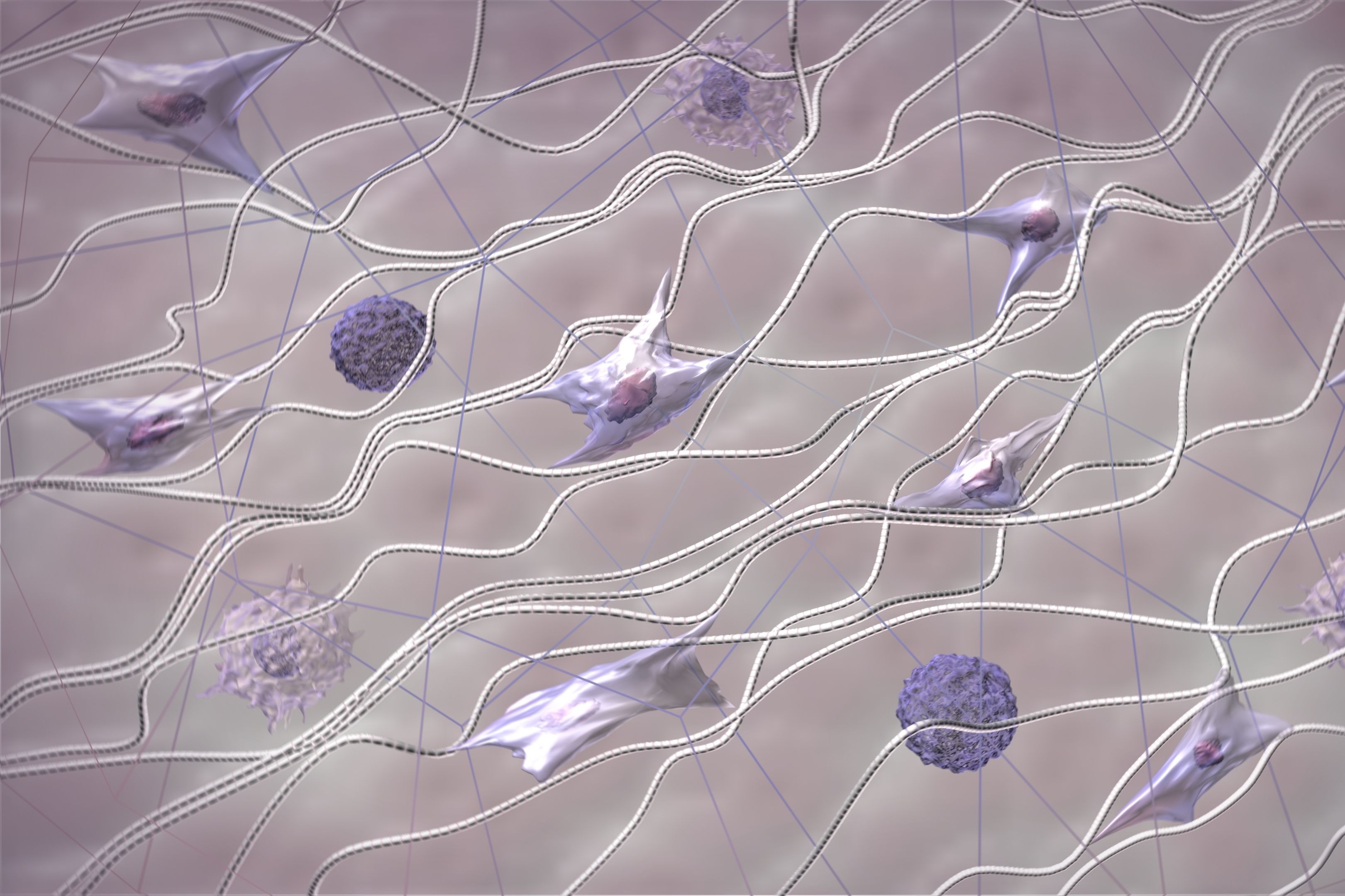
(Vienna, 11 November 2026) – Why the skin undergoes structural changes as we age is not yet fully understood. The role played by immune cells in this process and how they interact with connective tissue is the subject of current research. A study by the Medical University of Vienna now provides new evidence: in the skin of older mice, a specific group of immune cells (macrophages) is present which may be linked to inflammation and changes in connective tissue. In experiments using skin samples, the researchers were also able to shift the composition of these immune cells towards a younger state. The research findings have recently been published in the journal "Frontiers in Cell and Developmental Biology".
As part of the study, the research team at MedUni Vienna analysed skin samples from male mice aged eight, 26 and 52 weeks. This revealed a marked change in the composition of immune cells: whilst monocytes and macrophages accounted for around 1.5 per cent of the cells examined in the eight- and 26-week-old animals, their proportion in the 52-week-old mice was 16.41 per cent.
To better understand the interaction between immune cells and connective tissue, the research team also investigated how macrophages communicate with connective tissue cells, known as fibroblasts. The analyses provided evidence of enhanced signalling pathways between these cell types in older skin. Furthermore, changes were observed in genes involved in the formation and organisation of the connective tissue matrix. The results suggest that age-related changes in the composition of immune cells and connective tissue may be interlinked.
Newly identified cell group found only in the oldest group
"Particularly noteworthy is our discovery of a specific subgroup of macrophages that we were only able to detect in the oldest group studied," reports the study’s first author, Melanie Salek (Department of Dermatology, MedUni Vienna), on the research. "The newly identified cell group exhibits characteristics associated with inflammatory reactions and age-related changes in connective tissue function," explains study leader Michael Mildner (Department of Dermatology, MedUni Vienna).
Based on these findings, the researchers conducted experiments on skin samples from older mice using a cell secretion that was developed as part of a MedUni Vienna study and the effects of which had already been investigated in relation to scar formation and wound healing. The secretion, known as PBMC-sec (Peripheral Blood Mononuclear Cell Secretome, also APOSEC), is a mixture of substances released by blood cells that can influence inflammatory and repair processes in tissue.
The results of the experiments showed that, following a 24-hour treatment, the proportion of those macrophages that had only been detected in older mice decreased, bringing the composition closer to that seen in younger animals. "The results suggest that age-associated changes in immune cells and the associated processes of connective tissue remodelling can be influenced under experimental conditions," says co-lead author Hendrik Ankersmit (Department of Thoracic Surgery, MedUni Vienna), summarising the initial findings. As the treatment was tested exclusively on excised skin samples, further studies are needed to clarify whether the effects can also be achieved in living organisms or in humans.
Publication: Frontiers in Cell and Developmental Biology
Age-related changes in the phenotype and function of mouse skin macrophages and its modulation by PBMC-sec.
Melanie Salek, Katharina Klas, Lisa Auer, Attila Placido Sachslehner, Daniel Bormann, Bahar Golabi, Sophie Röder, Hannes Kühtreiber, Karin Pfisterer, Wolfgang Weninger, Clemens Aigner, Hendrik Jan Ankersmit*, Michael Mildner*.
https://www.frontiersin.org/journals/cell-and-developmental-biology/articles/10.3389/fcell.2026.1964728/full