
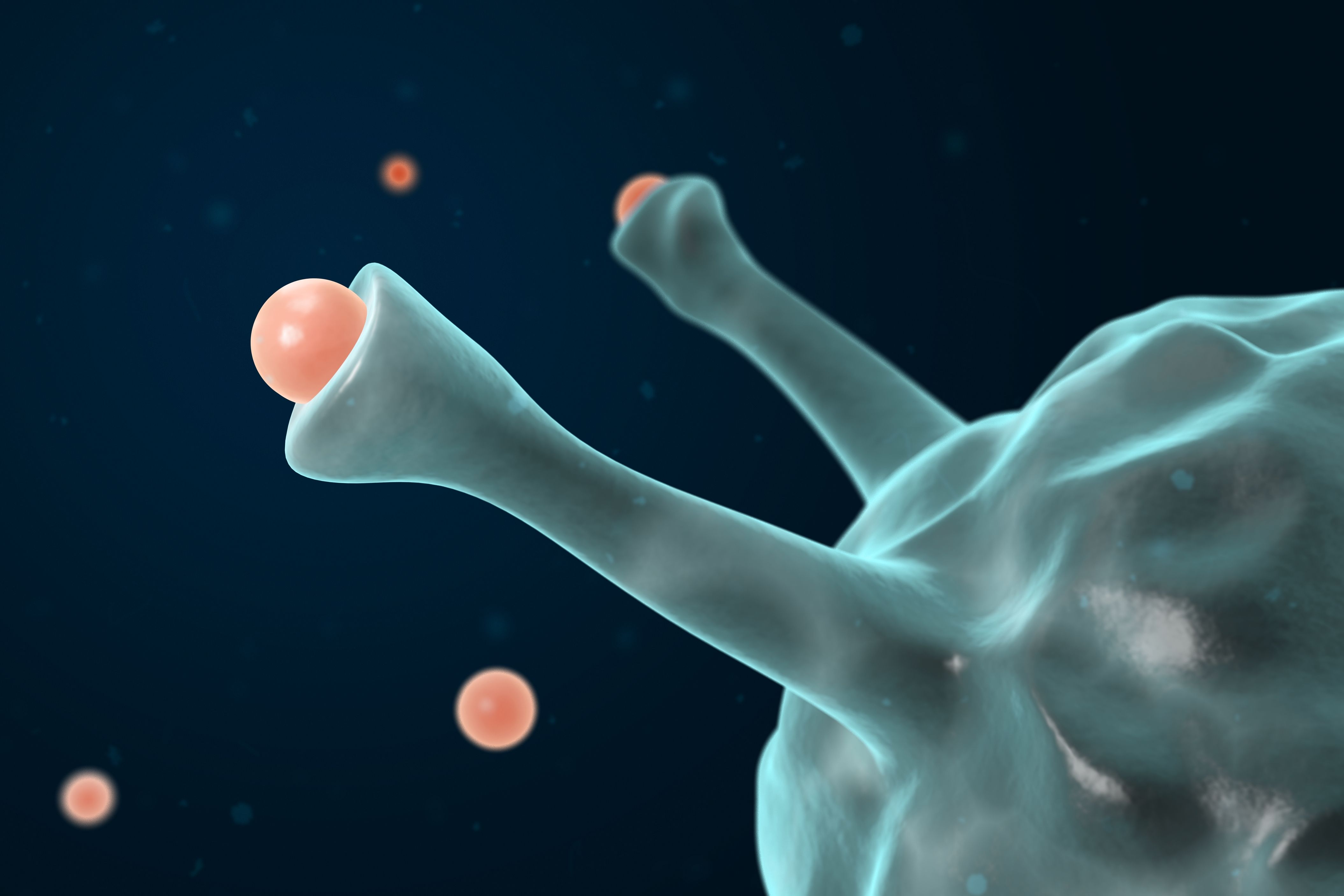
(Vienna, 27 October 2026) – An international research team led by MedUni Vienna has identified a previously unknown population of precursor cells in the bone marrow of adult mice. These cells can develop into various types of blood cells and, in particular, contribute to the formation of important immune cells known as macrophages. Published in Nature Immunology, the findings reveal an additional pathway by which macrophages can form in adult mice.
As key players in the immune system, macrophages recognise and eliminate pathogens, dead cells and other foreign substances, and play an important role in inflammatory responses and tissue regeneration. Many macrophages originate during embryonic development and maintain themselves by dividing within tissues. Monocytes – a type of white blood cell – provide an established source of new macrophages in adults. The newly identified EMPROR cells reveal an additional route. The team led by Shweta Tikoo, Rohit Jain and Wolfgang Weninger at MedUni Vienna’s Department of Dermatology identified a distinct precursor population, which they named EMPROR (Erythro-Myeloid PROgenitoR). They differ from previously known precursor cells in terms of their molecular characteristics and developmental potential. In the experiments, they were able to give rise to various cell types, including the immune system’s "scavenger cells", known as macrophages.
Macrophage formation also detected in tumour tissue
The researchers examined whether EMPROR cells could generate perivascular macrophages – specialised macrophages associated with blood vessels. Their experiments showed that EMPROR cells can give rise to these cells. Under the same experimental conditions, monocytes and the other precursor populations tested were less effective at generating these macrophages. Evidence of these precursor cells’ involvement in the formation of macrophages within the tumour microenvironment was also found in a mouse model of breast cancer. "The results thus suggest that EMPROR cells can contribute to the development of certain macrophage populations not only under normal conditions, but also in the context of inflammation and tumours," say first authors Shweta Tikoo and Rohit Jain.
EMPROR cells share molecular features and the ability to generate several blood cell types with precursors found during embryonic development. This suggests that adult bone marrow retains a similar blood-forming programme, although a direct developmental link has not yet been established.
Macrophages are found in almost all tissues of the body. Depending on their location, they perform various tasks – ranging from defending against pathogens to supporting tissue development and repair. Understanding how macrophages develop matters because their developmental origin, together with their tissue environment, can influence how they function. "Understanding macrophage formation is therefore not only a fundamental question in immunobiology, but may also, in the long term, open up new approaches for the research and treatment of diseases," says study leader Wolfgang Weninger, emphasising the relevance of the research findings. As the studies were carried out in mice, further studies are needed to clarify whether the newly identified EMPROR cells are also present in human bone marrow and what role they play there.
An accompanying study by the same team in "Nature Immunology" describes a related progenitor population in the newly identified MIXER tissue at the interface between the mother and the embryo.
Publication: Nature Immunology
A CD4-lineage erythro–myeloid progenitor within the adult bone marrow defines an alternative pathway for macrophage generation.
Shweta Tikoo, Rohit Jain, Brendon Martinez, Renhua Song, Matthias Wielscher, Carlos Márquez-Burgoa, Anastasiya Hladik, Simone Rizzetto, Lisa E. Shaw, Minoo Ghannadan,
Stephanie A. Gerhofer, Andrew J. Mitchell, Maria Elizabeth Torres-Pacheco, Fabio Luciani, Matthias Farlik, Justin J. L. Wong, Sylvia Knapp, Philipp Starkl, Stuart T. Fraser, Steffen Jung & Wolfgang Weninger.
https://doi.org/10.1038/s41590-026-02686-1