
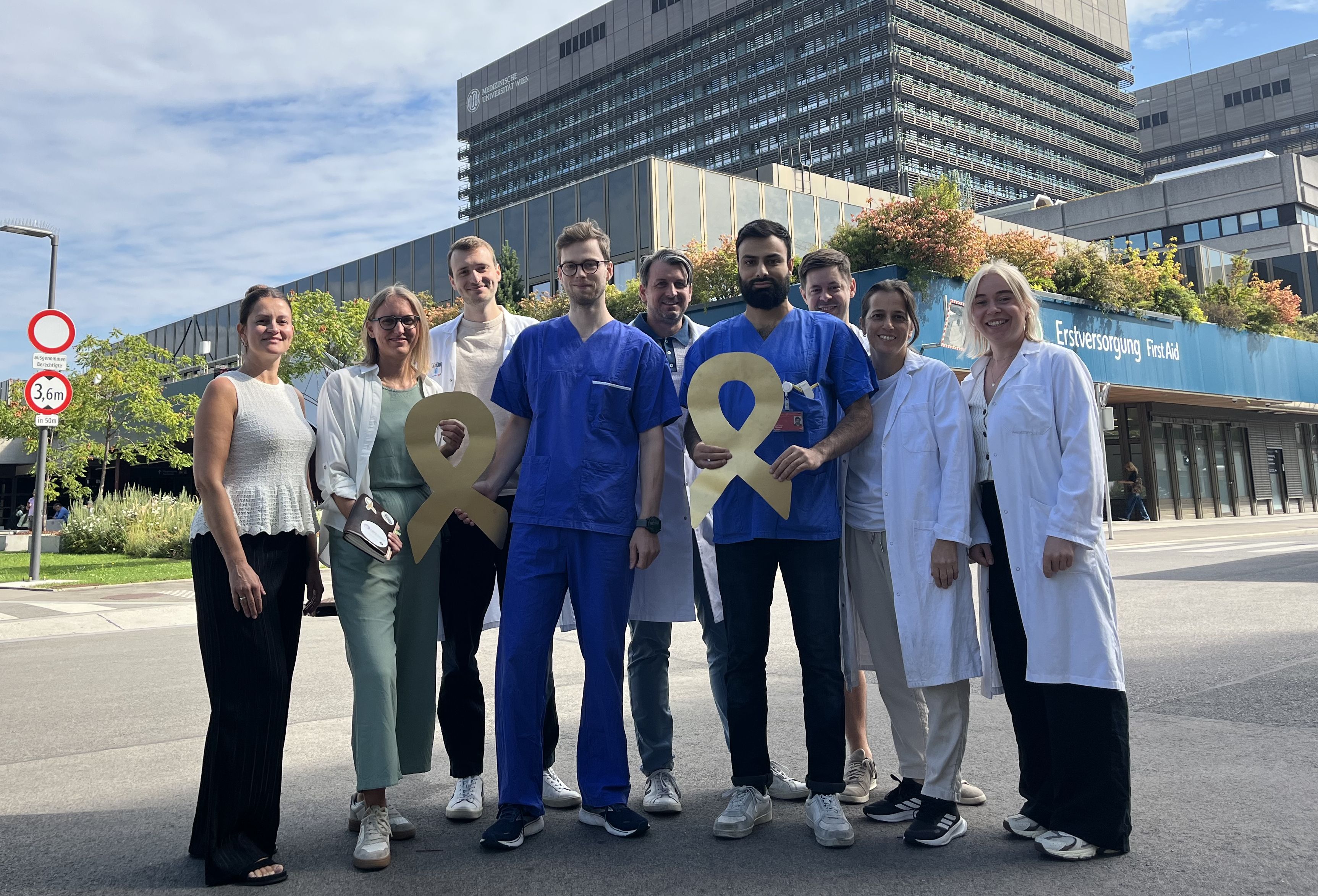
(Vienna, 27 August 2026) Around 400,000 children and adolescents worldwide are diagnosed with cancer every year. Whilst many tumour types in this age group are well treatable nowadays, brain tumours remain responsible for the majority of cancer-related deaths among young people. Hence, there is a significant need for research in this field to improve the survival rates and quality of life of those affected. To mark "Golden September", the awareness month for cancer in children and adolescents, Johannes Gojo (Department of Pediatrics and Adolescent Medicine at MedUni Vienna and University Hospital Vienna) discusses the latest developments and the importance of interdisciplinary care for young patients. To this end, the internationally renowned Brain Tumour Centre for Children and Adolescents has been established at MedUni Vienna and University Hospital Vienna.
In recent years, scientists have already demonstrated that there are more than 100 different types of brain tumours in children and adolescents – a key finding that has fundamentally transformed treatment. We now know that the prognosis depends crucially on the tumour type, its location, molecular characteristics and the corresponding treatment options. And yet, in many cases, the prognosis remains poor: whilst the 5-year survival rates for all childhood brain tumours combined in Europe and North America currently stand at around 75 to 80 per cent, this figure masks significant differences: children with low-grade gliomas often achieve long-term survival rates of over 90 per cent. In contrast, high-grade gliomas and diffuse intrinsic pontine gliomas (DIPG), for example, are among the most aggressive tumours in childhood, with an average survival of just twelve months.
"The enormous need for research into brain tumours stems not only from the high mortality rate," explains Johannes Gojo, Professor of Paediatric Neuro-Oncology at the Department of Pediatrics and Adolescent Medicine at MedUni Vienna and University Hospital Vienna, outlining the situation. "The high morbidity rate also continues to pose major challenges for science. Children and young people who have survived a brain tumour often suffer from long-term effects that require appropriate professional care."
Research focusing on precision medicine
Current research into brain tumours in children and young people is increasingly adopting the precision medicine approach. The aim is to better understand the molecular characteristics of individual tumours and to develop personalised treatment strategies based on this understanding. MedUni Vienna plays a key role in numerous international studies and research networks – including the coordination of the so-called MEMMAT study, in which children and adolescents with recurrent medulloblastomas and other tumour types are treated. Further areas of focus include particularly aggressive types of brain tumours, as well as the development of new tumour models that allow therapeutic approaches to be investigated in a more targeted manner in the laboratory. Liquid biopsy techniques, in which tumour components are analysed from bodily fluids to better characterise diseases, are also a focus of research for scientists at MedUni Vienna. As the disease affects the brain, particular attention is also paid to neuropsychological research.
Interdisciplinary patient care
"Brain tumours are particularly complex conditions whose treatment requires close collaboration between different specialist disciplines and professional groups," says Johannes Gojo, highlighting a further challenge. To this end, the internationally renowned Brain Tumour Centre for Children and Adolescents has been established at the Department of Pediatrics and Adolescent Medicine at MedUni Vienna and University Hospital Vienna, and is coordinated by Johannes Gojo. There, specialists in paediatric oncology, neurosurgery, radiology, radiotherapy, neuropathology, clinical psychology and other disciplines work together within an integrated care model to tailor diagnosis, treatment and aftercare to each individual’s needs. "In addition to tumour control, our centre also focuses on the long-term health, development and quality of life of our patients," says Gojo. That is why support is also provided for the psychosocial and functional consequences of cancer. Furthermore, there is close collaboration with patient representatives and organisations.
"Recent years have shown how crucial a deep understanding of the biological diversity of paediatric brain tumours is for progress in treatment. At the same time, aggressive subtypes in particular remain a major challenge. We must therefore continue to closely integrate research, international collaboration and clinical expertise. Our aim must be to develop new therapies more quickly in order to improve the survival rates and quality of life of the children and young people affected," says Johannes Gojo.
"Golden September" – Childhood Cancer Awareness Month:
Every September, gold-coloured ribbons and illuminations are used worldwide to draw attention to cancer in children and adolescents, with the aim of informing the public about the particular challenges faced by those affected and their families. MedUni Vienna and University Hospital Vienna are also sending a visible message of solidarity this month by illuminating the entrance area in gold from 1 to 7 September.