
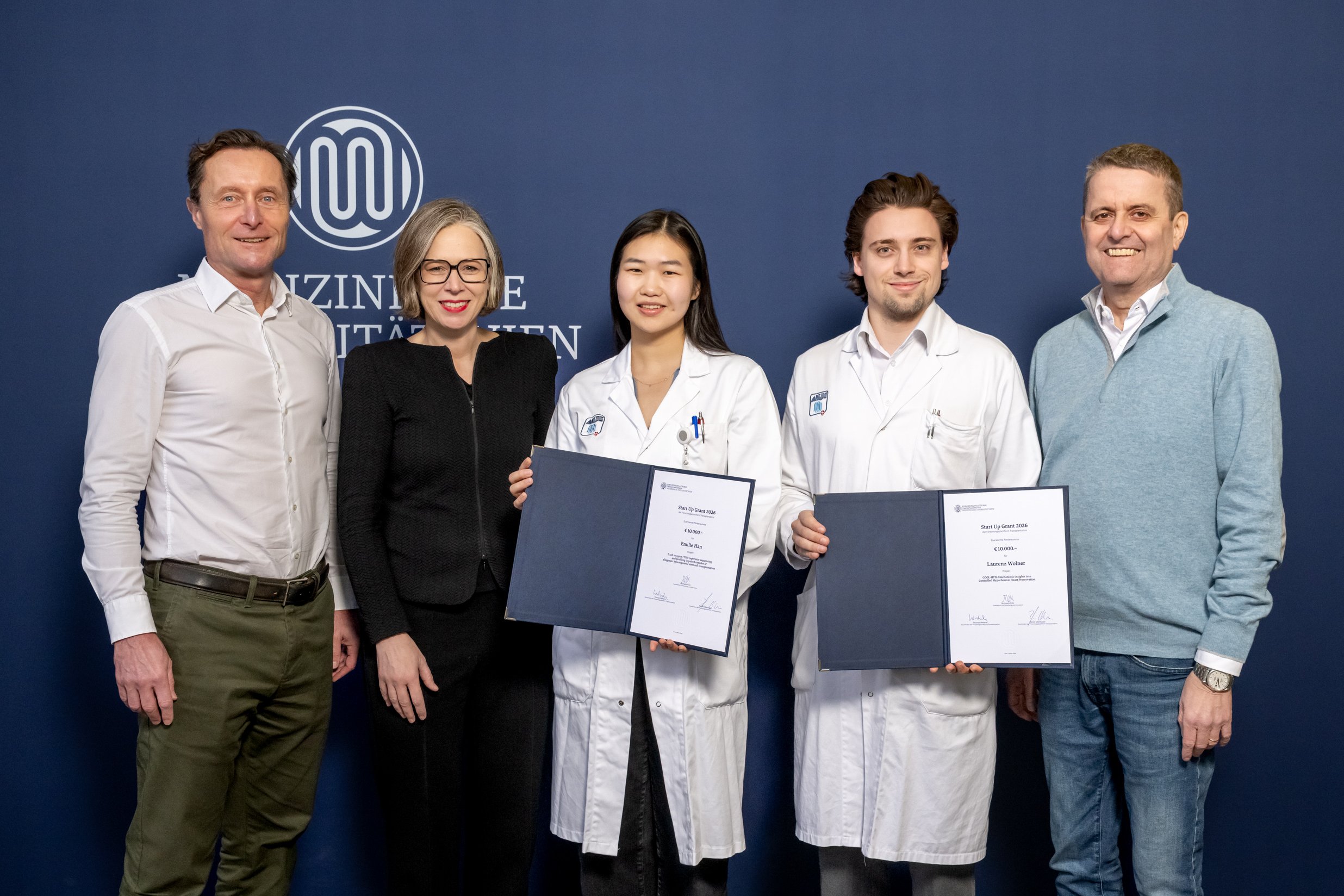
(29 January 2026) The Transplantation Research Platform at the Medical University of Vienna is awarding two start-up grants to specifically support young scientists in the field of transplantation research. Emilie Han and Laurenz Wolner will receive support for their projects on T-cell immune reconstitution after allogeneic stem cell transplantation and on hypothermic organ protection in heart transplantation.
The grants are intended to generate new research results that will serve as a basis for attracting third-party funding in the future. The awards were presented by Michaela Fritz, Vice-Rector for Innovation and Research, and the coordinators of the Transplantation Research Platform, Rainer Oberbauer and Thomas Wekerle.
About Emilie Han's project
Allogeneic haematopoietic stem cell transplantation is an established therapy for haematological diseases. Long-term therapeutic success depends on achieving remission and effective and balanced reconstitution of the immune system. Limited diversity of T-cell receptors (TCR) is associated with an increased risk of infections, disease relapse and the development of graft-versus-host disease (GvHD). These risks are increased after haploidentical transplantation compared to HLA-identical transplants, although the underlying immunological mechanisms have not yet been fully researched.
This pilot study investigates the composition and diversity of the TCR repertoire in recipients of haploidentical and HLA-identical stem cell transplants. By analysing paired donor and recipient samples, differences in T cell reconstitution and in the persistence and expansion of specific T cell clones are recorded. NGS analysis of TCR repertoires provides a detailed and quantitative characterisation of the adaptive immune system.
The results are intended to provide a structured comparison according to donor type and contribute to a better understanding of immune reconstitution, GvHD development and susceptibility to infection after allogeneic stem cell transplantation.
About Emilie Han
Emilie Han has been a trainee doctor at the Department of Transfusion Medicine and Cell Therapy since 2024 and is a founding member of NextGen Transfusion Medicine, a young professionals network and commission of the German Society for Transfusion Medicine and Immunohematology (DGTI). During her medical studies and after graduating in 2022, she worked as a research assistant at the Department of Medicine II, Division of Cardiology. There, she collaborated on a variety of clinical and experimental studies during her PhD programme. As part of a visiting research fellowship (funded by the Marietta Blau Scholarship) at the Cardiovascular Research Centre of NYU Langone Health in 2025, she conducted research at the Gianarelli Lab on the influence of immune cells on the development and progression of atherosclerosis.
About Laurenz Wolner's project
Heart transplantation remains the most effective therapy for patients with end-stage heart failure, but its success is significantly limited by ischaemia-reperfusion injury that occurs during donor heart procurement, preservation and reperfusion. The static storage on ice currently in widespread use is associated with uncontrolled temperature fluctuations and potentially harmful sub-zero exposures that can impair myocardial energy metabolism, mitochondrial function and the endothelium. Temperature-controlled hypothermic storage systems enable constant cooling, and initial clinical data show improved early transplant outcomes; however, the underlying mechanistic processes are not yet sufficiently understood.
The aim of this project is to systematically investigate, in a standardised ex vivo mouse model, how temperature-controlled hypothermic preservation affects functional recovery, energy metabolism and mitochondrial performance of the heart compared to classical ice storage. Isolated mouse hearts are stored under different preservation conditions after defined ischaemia and then reperfused. Functional recovery is analysed using Langendorff perfusion, while high-energy phosphates, energy charge and mitochondrial respiration parameters are determined. In addition, accompanying inflammatory processes are investigated. The results should clarify mechanistically how controlled hypothermia contributes to organ protection and provide a basis for optimising future preservation strategies in heart transplantation.
About Laurenz Wolner
Laurenz Wolner completed his studies in human medicine at the Medical University of Vienna in 2025 and is now a resident at the Department of Cardiac and Thoracic Aortic Surgery. He is currently completing his PhD in the "Vascular Biology" programme at the Center for Biomedical Research and Translational Surgery, where, in parallel with his clinical work, he is conducting research at the interface of experimental transplantation research, immunomodulation and organ protection. As part of his PhD project, he is investigating the role of regulatory T cells (Tregs) and their therapeutic benefits in heart transplants.