
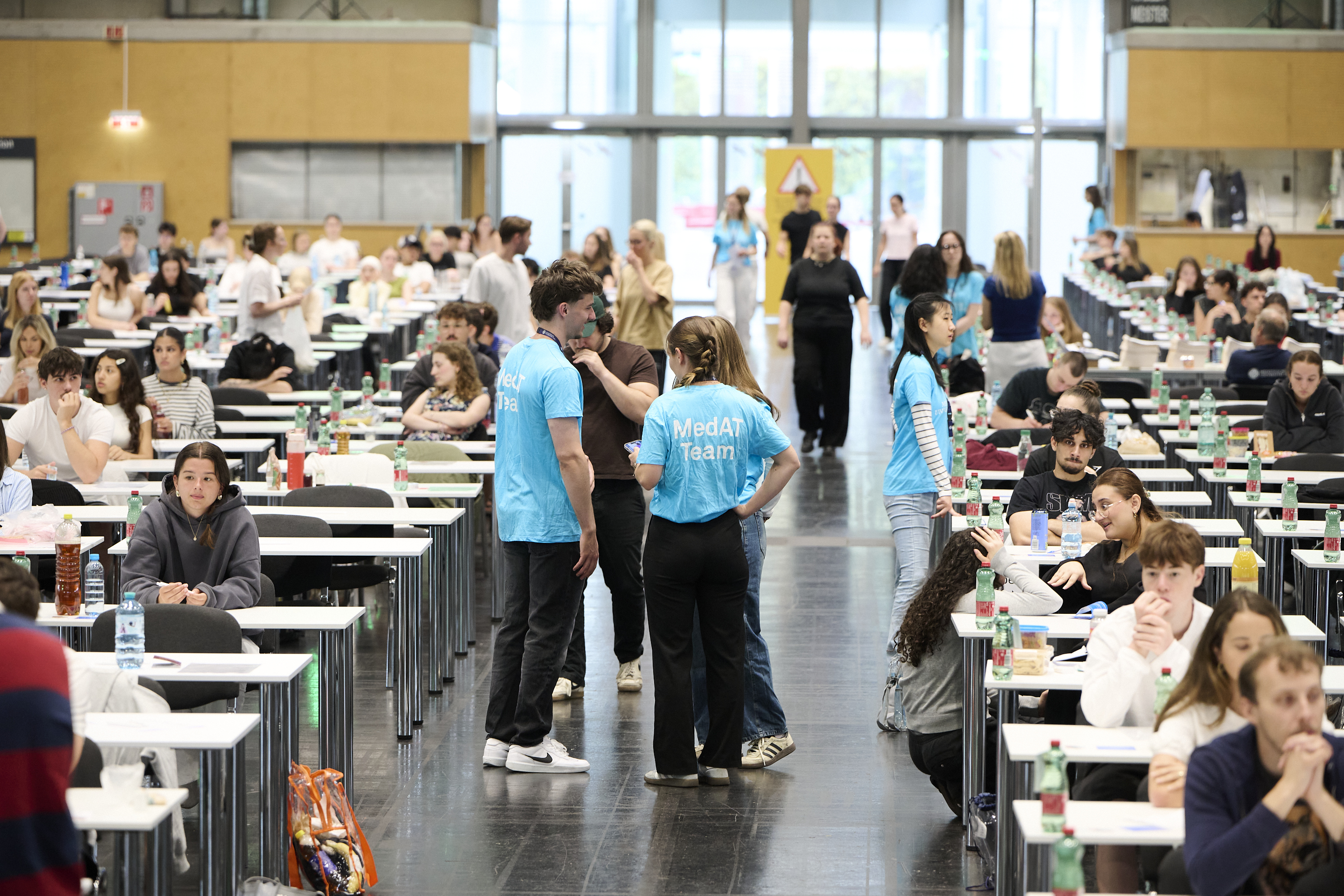
(Vienna/Graz/Innsbruck/Linz, 3 July 2026) Of the 16,880 candidates who originally registered, a total of 13,248 took part today, Friday, in the joint MedAT admissions process for places at the Medical University of Vienna, Innsbruck and Graz, as well as at the Faculty of Medicine at Johannes Kepler University Linz.
As in previous years, the entrance examinations were held at several venues across Austria. The MedUni Vienna examinations took place at Messe Wien; in Graz, the venues were the Stadthalle Graz; and for the Linz venue, the examinations were held at Messe Wels. In Innsbruck, the examinations for the Medical University of Innsbruck took place at Messe Innsbruck.
Participation figures in detail:
- A total of 6,573 people sat the entrance exam at MedUni Vienna; 8,235 applications had originally been received.
- At the Medical University of Innsbruck, a total of 2,630 people sat the test today, Friday. By the end of March, 3,532 people had registered online.
- At the Medical University of Graz, where there had originally been 2,824 registrations, a total of 2,321 candidates were recorded this Friday.
- At the Faculty of Medicine at JKU Linz, 1,724 people took part; by the close of the online registration period, 2,289 prospective students had registered.
Content of the MedAT-H and MedAT-Z entrance examinations
The entrance test for human medicine (MedAT-H) is a multi-part, written examination and is divided into the following sections:
- Basic Knowledge Test in Medical Studies: Assessment of prior school-based knowledge in the subjects of biology, chemistry, physics and mathematics.
- Reading comprehension: Assessment of reading skills and understanding of texts.
- Cognitive abilities and skills: This section of the test consists of five task groups (assembling figures, number sequences, verbal fluency, memory and recall, and recognising implications) and assesses basic cognitive abilities and skills.
- Social-emotional skills: This section of the test comprises the task groups ‘Recognising emotions’, ‘Regulating emotions’ and ‘Social decision-making’, which assess key aspects of social-emotional skills.
The entrance test for dentistry (MedAT-Z) is largely identical to the MedAT-H. Instead of the ‘Text Comprehension’ section and the ‘Recognising Implications’ task group, the ‘Manual Skills’ section includes the task groups ‘Wire Bending’ and ‘Mirroring Shapes’.
A total of 1,950 places
For the 2026/27 academic year, a total of 1,950 places are available for the degree programmes in medicine and dentistry (50 more than in the previous year), of which 784 are at the Medical University of Vienna, 430 at the Medical University of Innsbruck, 406 at the Medical University of Graz and 330 at the Faculty of Medicine at JKU Linz (in Linz, only human medicine). At least 95 per cent of the places are reserved for EU citizens and persons treated as equivalent to them in terms of access to higher education, and at least 75 per cent of the places are reserved for applicants holding an Austrian school-leaving certificate. However, this quota system applies only to the allocation of places on the human medicine programme.
In the 2026/27 academic year, up to 87 places in human medicine out of the 1,950 medical study places will be available for roles in the public interest for the federal states, the Austrian Health Insurance Fund, the Federal Ministry of the Interior and the Federal Ministry of Defence. Applicants wishing to apply for such a dedicated place must have taken part in the regular application process for their chosen location and, as part of an agreement with the relevant institution, undertake to actually carry out the duties in the public interest. Further details are available at www.medizinstudieren.at.