
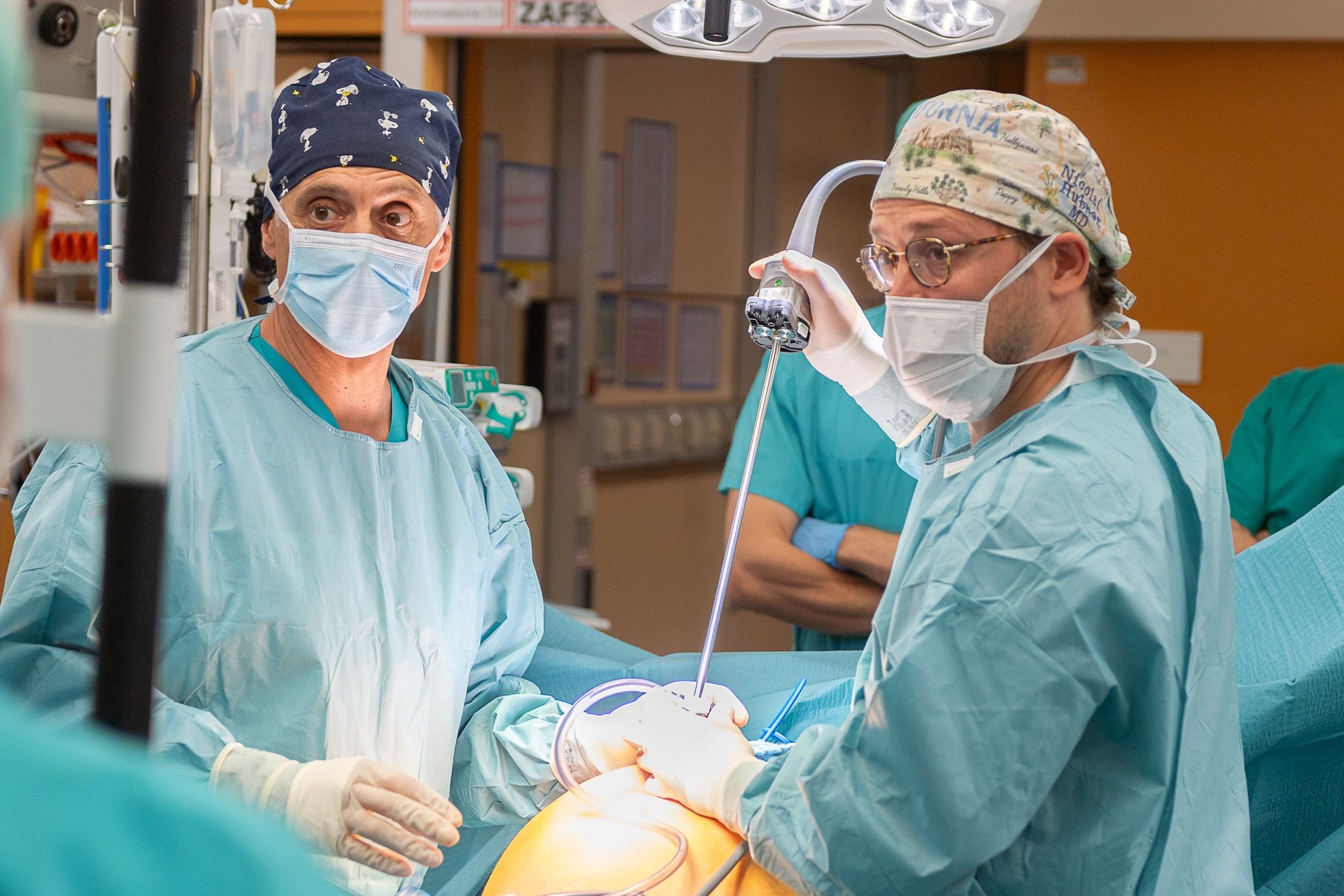
(Vienna, June 2, 2026) A new surgical approach to prostate cancer at MedUni Vienna and University Hospital Vienna no longer automatically centers on the removal of the prostate, but rather on the precise robotic treatment of the tumor while preserving quality of life, continence, and sexual function to the greatest extent possible.
At the Department of Urology at MedUni Vienna and University Hospital Vienna, a new robot-assisted surgical strategy is being implemented as part of a study involving selected patients with prostate cancer: Instead of removing the entire prostate, the approach involves the targeted treatment of the tumor with a safety margin while preserving healthy tissue. The focus is thus not only on tumor control and oncological safety but also on the outcomes that are particularly important for patients after surgery: continence, sexual function, and quality of life.
This approach has been made possible by several advances in recent years: Prostate cancer is now detected earlier more often. Modern anatomical and functional imaging allows for a much more precise depiction of the tumor’s location and extent. And improved molecular and clinical risk stratification helps identify those patients for whom a function-preserving approach is oncologically sound and clinically justifiable. What was once technically and conceptually nearly impossible can now be evaluated and implemented in carefully selected patients.
Treating the tumor, not the entire prostate
"We are witnessing a real transformation in prostate cancer surgery. For decades, radical removal of the entire prostate was the standard. With the new precision surgery, we can take a different approach in carefully selected patients: We treat the tumor with a safety margin while simultaneously attempting to preserve as much healthy tissue and as many functions as possible. This is patient-centered cancer surgery," says Shahrokh F. Shariat, Director of the University Clinic for Urology and the Comprehensive Cancer Center at MedUni Vienna and University Hospital Vienna.
A shift similar to that seen in breast cancer
The new, precise, prostate-preserving surgery for prostate cancer follows a paradigm shift already familiar from breast cancer treatment: moving away from maximally radical approaches toward targeted, function-preserving procedures. This is comparable to the shift from complete breast removal (radical mastectomy) to what is known as a lumpectomy, in which only the tumor is removed with a safety margin and the breast is preserved. In precise prostate surgery as well, the goal is to remove only the affected tissue in selected patients while sparing as much healthy tissue as possible. "In breast cancer, treatment has evolved from radical mastectomy to mastectomy and then to lumpectomy. That is exactly what we are doing now with the prostate," explains Shahrokh Shariat.
First center outside the U.S.
The technique underlying the method was developed in New York. The Department of Urology at MedUni Vienna and University Hospital Vienna is the first center worldwide outside the U.S. to implement this procedure. To support the implementation of this approach, a specialized team from New York led by Mani Menon is visiting the Department of Urology in Vienna. Together, they are conducting a scientific evaluation of the method’s introduction.
Combining high oncological safety with preservation of function
"This procedure represents a new level of surgical precision. The key factors are the very careful selection of suitable patients, precise preoperative imaging, and technically highly precise robot-assisted execution in the operating room," says Mesut Remzi, Deputy Director of the University Clinic for Urology at MedUni Vienna and University Hospital Vienna.
The new method is being further developed and applied at the Department of Urology by a specialized team led by Shahrokh F. Shariat, Mesut Remzi, Christian Seitz, and Nicolai Hübner.
About the Department of Urology
The Department of Urology at MedUni Vienna and University Hospital Vienna is one of Europe’s leading urological oncology centers. Together with the Comprehensive Cancer Center Vienna, it aims to closely integrate innovative research, modern diagnostics, and highly specialized therapy to provide patients with access to advanced and optimal treatment strategies.