

(Vienna, 20-03-2025) A proof-of-concept study by MedUni Vienna has shown that printed letters on overlapping sheets of paper can be made visible using high-resolution magnetic resonance microscopy (MRM). The results, currently published in Nature Communications Engineering could open up new perspectives for cultural studies and medical imaging in the long term.
Conventional clinical magnetic resonance imaging (MRI) achieves a spatial resolution in the range of approximately one cubic millimeter. However, printed pigment layers are only a few micrometer, or thousandths of a millimeter, thick and do not themselves generate a usable MR signal. Considering this background, Andreas Berg from the Center for Medical Physics and Biomedical Engineering at MedUni Vienna asked himself whether letters in closed books could be deciphered using high-resolution MR imaging, specifically MRM.
The experiments with adapted data processing, published jointly with Alexander Seewald (Seewald Solutions GmbH), were carried out on a research magnetic resonance tomograph for human examinations (B = 7T) at the High Field MR Centre of MedUni Vienna. In addition, a prototype microscopy gradient insert was used on the patient bed, which allows tissue – or in this case, a stack of paper – to be visualized in minute detail, not only in layers (2D) but also spatially (in 3D). In the experiments, three-dimensional pixels, known as voxels, with an edge length of around 20 micrometers (0.02 millimeters) were generated.
Since dry paper and dry printing ink do not produce an MR-compatible signal, a chemically inert silicone oil was applied between the layers of paper. This oil generates a strong MR signal, but is displaced by the minimal elevations of the printing ink. This creates a so-called negative contrast: the letters appear in the three-dimensional data set as structures with a weaker signal against the bright background of the liquid.
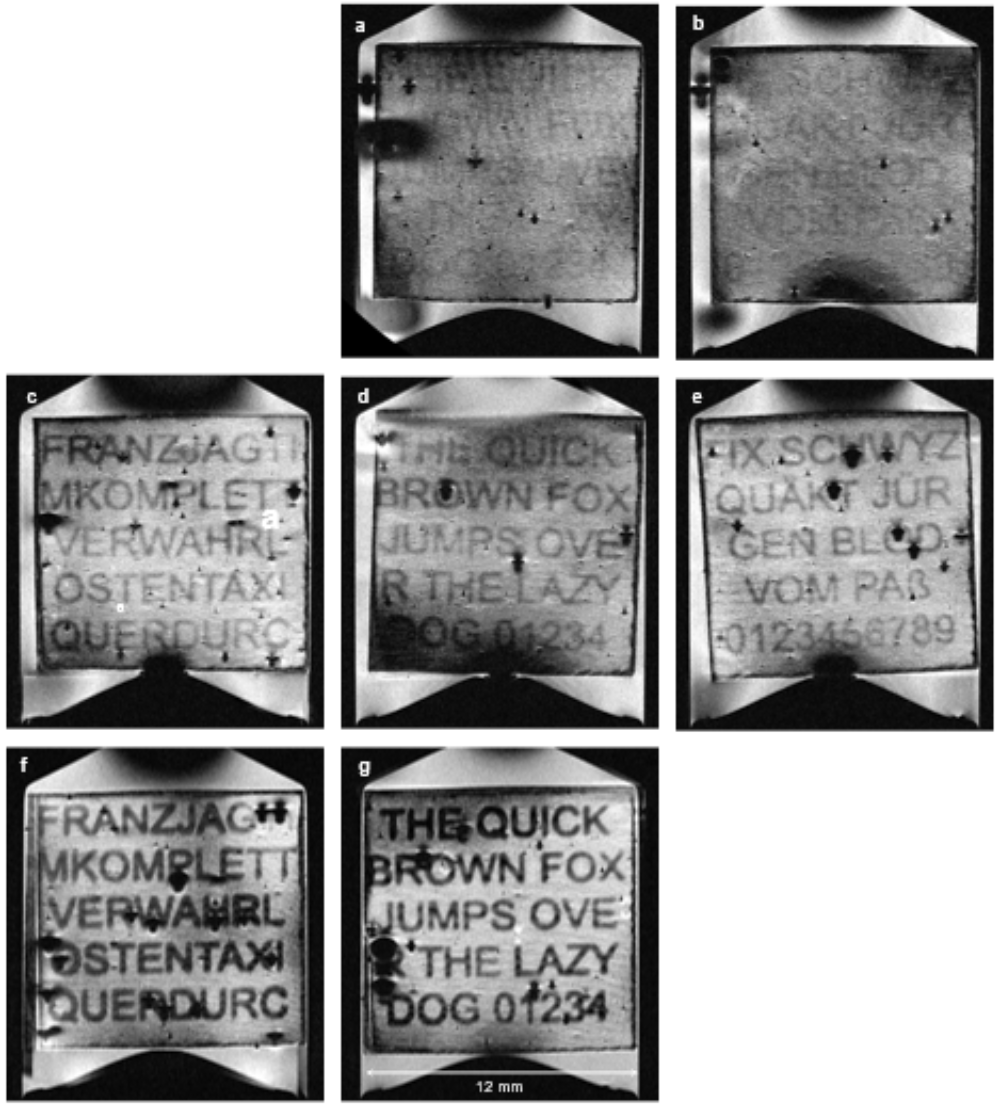
Positive results with limitations
"Of course, we did not use historically valuable original documents for our investigations, but specially prepared printed pages," reports Andreas Berg. Individual letters and short text passages were printed on nine sheets of paper laid on top of each other. In order to create different layer thicknesses, the color printing was carried out several times on top of each other – two, four and eight times. The resulting print layer thicknesses were approximately 14, 28 and 56 micrometers. Legible results were achieved in particular with a print thickness of around 30 micrometers, when the voxel size was comparable to the printer ink thickness.
The three-dimensional measurements took up to 37 hours. Since paper pages can be slightly curved, the researchers also developed a mathematical data analysis method to reconstruct the page shape. This involves mathematically modelling of the curved surface and virtually "smoothing" it so that text can be calculated along the actual page surface and displayed in a more legible form.
The study thus shows that MR microscopy can indeed make text in closed stacks of paper or books visible in principle. However, in its current form, the method has limitations and is not yet suitable for use on historically valuable manuscripts, for example: "On the one hand, the paper size was limited to about two centimeters in diameter due to the sensitive radio-frequency detector coil, which was restricted with inner diameter for encompassing the sample. On the other hand, it may not be possible to completely remove the liquid that has been introduced without impact on sensitive valuable manuscripts," says Berg.
Possible perspectives for the examination of tissue samples
The study results could open up possible perspectives not only for cultural studies, but also for medicine: high-resolution MR microscopy could, for example, be used for the detailed imaging of small tissue structures, e.g., for their 3D microscopic morphologic structure without destroying them (MR-based histology). High-resolution MR images of minute pathologies will also be essential for radiological diagnosis in an early state of developing pathologies. The training of AI-based radiological diagnostic procedures on the basis of MR-microscopic images ex-vivo (MR-based histology) will support the diagnostic interpretation of MR-micro-images in-vivo on humans, which will be available in the future. The advantage of using an MR microscopy unit on a human scanner (rather than, for example, on an animal MR scanner) lies in the possibility of first performing in-vivo measurements on patients and then performing ex-vivo measurements on small tissue samples using the same contrast weighting and MR measurement protocols in the microscopy insert on the patient layer. Improved methods for surface modelling and three-dimensional reconstruction could also be used in the analysis of complex anatomical structures.
Magnetic resonance imaging is primarily used in medicine to visualize soft tissue in the human body. In cultural heritage research, X-ray-based methods such as absorption-based micro-computed tomography (µ-CT) are currently more widespread. However, this only provides good contrast with metallic inks. The MR-based approach now being presented uses a different physical principle and shows that even non-metallic printing inks can be indirectly visualized under suitable conditions. Further technical developments are needed to expand the range, breadth of application and practicality of MRM as a non-destructive imaging technique.
Publication: Nature Communications Engineering
Visualization of text on bowed sheets via High-resolution 3D-Magnetic Resonance Micro-imaging for potential reading of closed books: the proof-of-Concept.
Andreas Berg, Alexander Seewald.
https://doi.org/10.1038/s44172-026-00614-7