
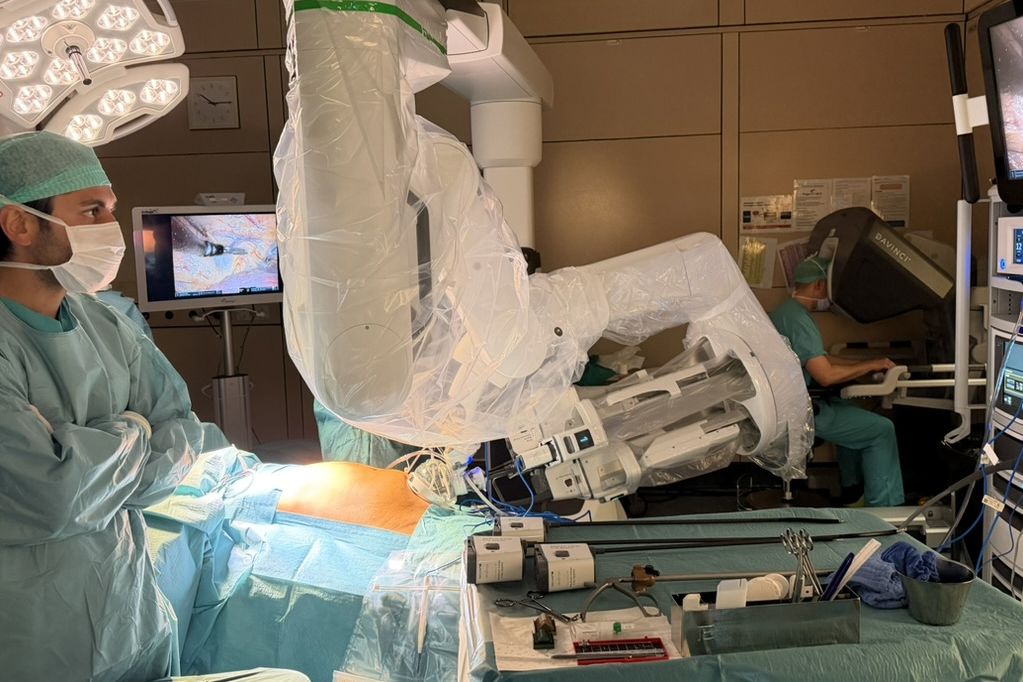
(Vienna, 10 November 2026) A significant breakthrough in transplant surgery has been achieved at University Hospital Vienna (AKH) and MedUni Vienna: on 20 October 2026, for the first time in Europe, both kidney retrieval from a female donor and the subsequent kidney transplantation into the recipient were carried out using the latest Da Vinci surgical robot system. The procedures were performed using the particularly gentle ‘Single Port’ (SP) surgical technique. With this latest generation of surgical robots, only a single small skin incision is required, through which all instruments and the camera can be inserted.
Robot-assisted kidney transplants have been performed at University Hospital Vienna (AKH Vienna) and MedUni Vienna since the end of 2024. Fifty-two kidney transplants have already been carried out using minimally invasive techniques. University Hospital Vienna and MedUni Vienna are thus among the leading European centres for robotic transplant surgery. However, until now, multiple skin incisions were still required for the individual instrument ports. Surgery using the new Da Vinci Single-Port System now makes it possible to carry out kidney transplants through a single small skin incision.
“What makes this new technology special is that all the instruments and the camera are inserted through a single skin incision. Inside the body, the instruments unfold using movable joints modelled on human elbows and wrists. This enables surgeons to carry out these highly precise and complex procedures through a single access point,” says Robert Öllinger, Head of the Division of Transplantation at the Department of General Surgery at University Hospital Vienna and MedUni Vienna.
Robot-assisted kidney transplantation using the Da Vinci Single-Port System had previously been performed at only one other European centre. The fact that both kidney retrieval from the donor and the transplantation into the recipient have now been carried out using this technology at University Hospital Vienna and MedUni Vienna is a unique achievement in Europe.
Fewer incisions, faster recovery
The new technique offers significant advantages for patients. The skin incision is only around six to seven centimetres long – just large enough to retrieve the kidney from the donor or insert it into the recipient. The technique allows access to the retroperitoneal space through a particularly gentle approach: a Pfannenstiel incision, which is also used, for example, in caesarean sections. With the Pfannenstiel incision, the abdominal wall remains intact; no muscle layers are cut through. The rectus abdominis muscles are simply temporaily retracted to either side during the operation. For patients, this less invasive procedure means less post-operative pain, a faster recovery and a shorter hospital stay. Just how quickly recovery can take place is demonstrated by the first pair of siblings to undergo surgery using this technology at University Hospital Vienna (AKH Vienna) and MedUni Vienna. Following the procedures, the donor was able to leave University Hospital Vienna after two days and the recipient after six days. This particularly gentle surgical method is suitable for all patients whose blood vessels allow the use of robotic clamps. Around 90 per cent of living-donor kidney transplant recipients meet this criterion.
Outlook: Expansion to liver transplants and kidney transplants in children
“The next step is to extend the use of this technology to liver transplants, particularly in the case of living-donor transplants. The new technology is also of particular significance for paediatric kidney transplants,” says Jakob Eichelter, Programme Director of Robotic Transplant Surgery at the Division of Transplantation, Department of General Surgery at University Hospital Vienna (AKH) and MedUni Vienna, looking ahead to the future. Until now, the use of the Da Vinci robotic system in children has been limited by their body size, as four incisions spaced at least six centimetres apart were required to operate the robot. “We have already achieved important milestones this year and performed kidney transplants on three children. These were still carried out using conventional open surgery. Our goal for the near future is to be able to operate on our young patients using minimally invasive techniques with the single-port system,” emphasises Robert Öllinger.