
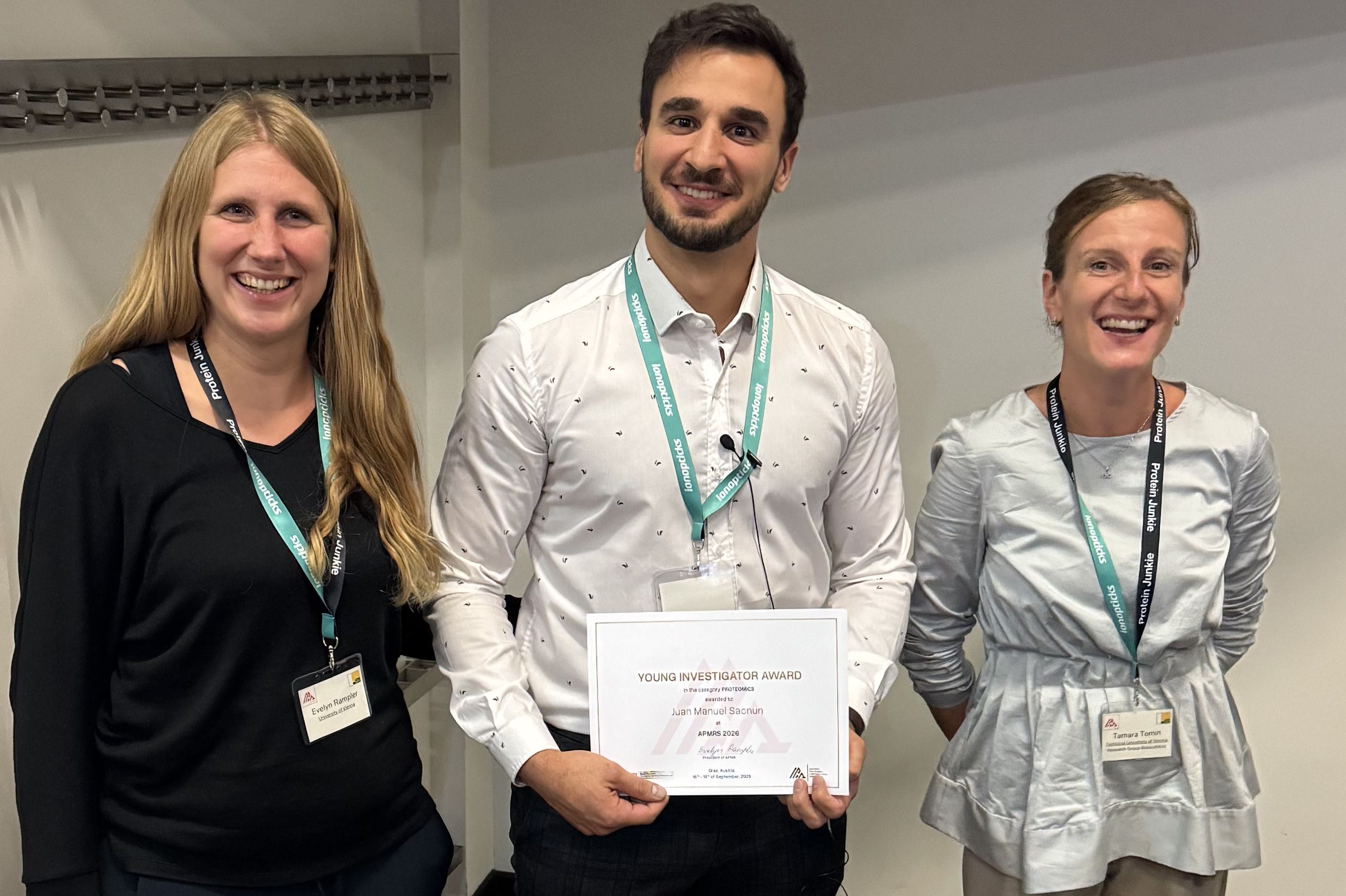
(Vienna, 07 October 2026) For his research in cellular communication during peritoneal dialysis, Juan Manuel Sacnun, a former PhD student in the Department of Paediatric Nephrology and Gastroenterology at the Department of Pediatrics and Adolescent Medicine at MedUni Vienna and now a postdoctoral researcher at the Department of Medicine III, has been awarded the ‘Best Proteomics Publication of the Year’ award by the Austrian Proteomics and Metabolomics Association (APMA). The award ceremony took place as part of the Austrian Proteomic and Metabolomic Research Symposium (APMRS) at the University of Graz. The award-winning paper is also the cover story of this issue of the journal “Science Signaling”.
The award recognised the paper ‘Deep secretome analysis reveals the effects of LiCl on fibroangiogenic remodelling in coculture and mouse models of peritoneal dialysis’, published in Science Signaling in 2026. The work was carried out as part of Sacnun’s PhD research at MedUni Vienna and was conducted in collaboration with an interdisciplinary research team.
The study focuses on the question of how the dialysis solutions used in renal replacement therapy with peritoneal dialysis (peritoneal dialysis) influence communication between different cell types in the peritoneum. To this end, the researchers developed a deep secretome profiling method that enabled them to investigate the interactions between human mesothelial cells and primary lymphatic endothelial cells.
By analysing more than 1,900 proteins in the secretome, the researchers were able to identify signalling pathways that were not visible in conventional cell culture models. The researchers then integrated these data with proteomic data from dialysate and plasma from patients undergoing peritoneal dialysis. This enabled them to characterise cell-type-specific signalling networks and correlate them with clinical parameters such as ultrafiltration rate, transport kinetics and inflammatory processes.
Further experiments showed that the addition of lithium chloride (LiCl) can partially attenuate certain fibroangiogenic signalling processes triggered by the dialysis solution. The findings provide new insights into the molecular mechanisms contributing to fibrosis and vascular changes in the peritoneum during long-term peritoneal dialysis, and lay the groundwork for the development of new therapeutic approaches. The publication was also selected as the cover story for "Science Signaling".
Research at the Christian Doppler Laboratory for Peritoneal Dialysis
The work was carried out primarily as part of Sacnun’s research within the international EU project IMPROVE-PD and at the Christian Doppler Laboratory for Molecular Stress Research in Peritoneal Dialysis (CDL-MSRPD) under the direction of Klaus Kratochwill. The laboratory investigated the molecular mechanisms underlying complications of peritoneal dialysis, utilising, amongst other things, modern proteomics, metabolomics and other omics methods.
Building on this research, the Christian Doppler Laboratory for Metaflammation in Peritoneal Dialysis (CDL-PRIME-PD), established in 2026 and headed by Rebecca Herzog – co-last author of the award-winning publication – is investigating new questions regarding the local and systemic consequences of peritoneal dialysis. The focus is on chronic inflammatory processes and what is known as metaflammation.
From peritoneal dialysis to rheumatology
Juan Manuel Sacnun completed his degree in biotechnology at the University of Rosario in Argentina. He completed his PhD training at MedUni Vienna as part of the POET (Programme for Organ Replacement and Transplantation) doctoral programme within the framework of the international Marie Skłodowska-Curie project IMPROVE-PD at the Department of Paediatric Nephrology and Gastroenterology of the Department of Pediatrics and Adolescent Medicine, as well as at the Christian Doppler Laboratory under the supervision of Klaus Kratochwill and Rebecca Herzog.
Sacnun is now continuing his research at the Department of Medicine III, Division of Rheumatology. As a postdoctoral researcher, he is part of Michael Bonelli’s research group. His current research focuses on cell-cell communication between immune cells and resident cells in autoimmune diseases. Sacnun utilises systems biology-based multi-omics approaches, particularly proteomics, to characterise signalling networks between different cell populations and to decipher the mechanisms of cell communication.
Publication: Science Signaling
Sacnun JM, et al. Deep secretome analysis reveals the effects of LiCl on fibroangiogenic remodelling in co-culture and mouse models of peritoneal dialysis. Science Signaling. 2026;19(935). DOI: 10.1126/scisignal.ady2586.