
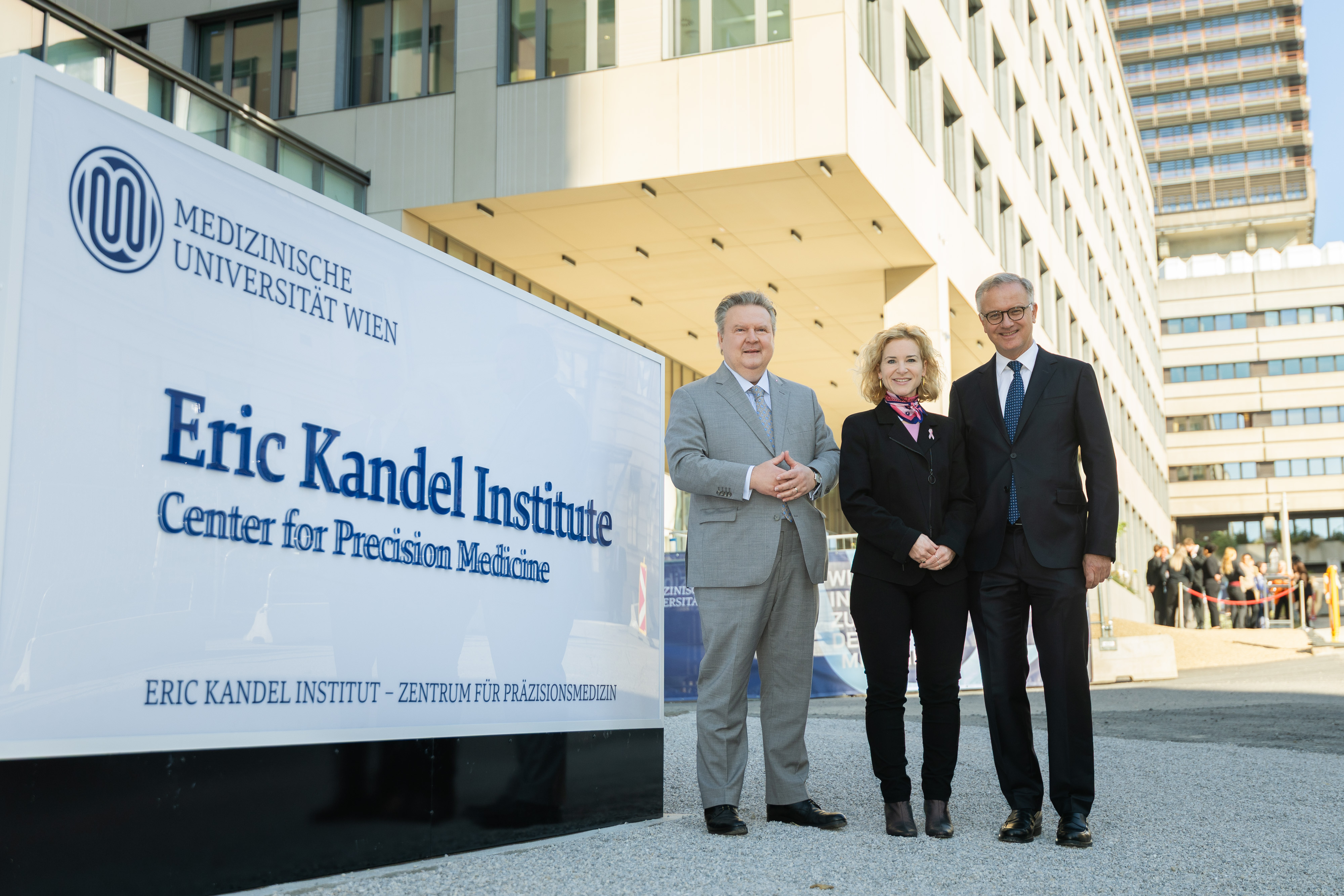
(Vienna, 1 October 2026) The Centre for Translational Medicine and the Eric Kandel Institute – Centre for Precision Medicine were officially opened today at the MedUni Campus AKH of the Medical University of Vienna and University Hospital Vienna (AKH). The two new research buildings at the MedUni Vienna and University Hospital Vienna site create unique conditions for translating findings from basic research into clinical application and for tailoring prevention, diagnosis and treatment more closely to individual needs. The press conference marking the opening was attended by Markus Müller, Rector of MedUni Vienna; Eva-Maria Holzleitner, Federal Minister for Women, Science and Research; and Michael Ludwig, Mayor of Vienna.
With these two research centres, two closely interlinked strategies for medical innovation of the highest international standard are being further developed at the MedUni Campus AKH: whilst translational medicine focuses on transferring scientific findings from basic research into medical practice, precision medicine emphasises the consideration of individual, biological and molecular differences. The direct connection of the two buildings to the main complex of the University Hospital Vienna via bridges enables an immediate link between innovative research and day-to-day patient care. MedUni Vienna has named the Centre for Precision Medicine and the largest lecture theatre at MedUni Vienna within the Centre for Translational Medicine after two eminent figures in medicine, both born in Vienna in 1929. The names of Nobel Laureate Eric Kandel and the father of modern cardiology, Eugene Braunwald – who were forced to flee as children following Austria’s annexation by Nazi Germany in 1938 – will thus be immortalised at MedUni Vienna for future generations.
“Today, with Eric Kandel and Eugene Braunwald, we are honouring two outstanding figures in medicine. The Kandel and Braunwald families, through their presence as guests of honour, underscore their deep connection to our university. With these two new centres, the foundations are being laid here in Vienna – particularly for future generations – for two key areas of modern medicine: the rapid translation of scientific findings into clinical practice and an increasingly precise, personalised form of medicine,” said Markus Müller, Rector of MedUni Vienna.
“We do not invest in research for its own sake. We invest in research because it can improve our lives. With the new Centre for Translational Medicine and the Eric Kandel Institute, we are creating the best possible conditions for scientific findings to be translated more quickly into tangible progress for patients. We invest in research because it makes our society stronger and our future better,” said Eva-Maria Holzleitner, Federal Minister for Women, Science and Research.
“With the Centre for Translational Medicine and the Eric Kandel Institute, Vienna is sending a strong signal as an international health and research hub. When cutting-edge research and patient care work side by side, new therapies reach those who need them – the people in our city – more quickly and precisely. After all, cutting-edge medicine must not become a matter of income in Vienna,” emphasised Mayor Michael Ludwig, adding:
“The fact that the Centre for Precision Medicine bears the name of our honorary citizen Eric Kandel fills me with pride and is, at the same time, a mission: today’s Vienna is a city that welcomes bright minds – and does not drive them away. A city that offers a home to research and innovation.”
The keynote speech at the opening was delivered by Robert A. Harrington, Dean of Weill Cornell Medicine in New York. His address covered the topics of translational medicine and academic medicine.
From the laboratory to early-phase clinical research under one roof
The Centre for Translational Medicine (CTM) comprises around 14,000 square metres of floor space, of which approximately 11,700 square metres are dedicated to research and 2,300 square metres to teaching. At its heart lies the principle of translational medicine – “from the laboratory to the bedside and back to the laboratory”: findings from basic research are to be made available to patients as quickly as possible, whilst insights from clinical care in turn inform new research questions. To this end, the CTM brings together the entire development chain – from experimental laboratory investigations to clinical Phase I/II research – under one roof.
The infrastructure includes, amongst other things, a clinical centre for Phase I and Phase II trials, laboratory and research spaces, a biobank, facilities for bioinformatics and pre-clinical research, as well as GMP units for cell therapy, radiopharmacy and biologics. Core facilities provide research groups with access to specialised technologies and equipment. Thanks to the direct link to the main building of University Hospital Vienna, basic research, clinical research and patient care are also brought closer together in physical terms. The total investment for the CTM amounts to around 120 million euros and is funded by the federal government and the City of Vienna.
In the new Centre for Translational Medicine, the Eugene Braunwald Auditorium – MedUni Vienna’s largest lecture theatre – is named after Eugene Braunwald (1929–2026). The Austrian-American cardiologist is regarded as one of the defining figures in modern cardiology. Braunwald passed away on 22 April 2026 at the age of 96 in Massachusetts, USA.
Precision medicine based on individual characteristics
The Eric Kandel Institute – Centre for Precision Medicine (CPM) is creating a specialised research infrastructure for personalised and digital medicine across an area of approximately 6,100 square metres. In future, around 200 researchers will work here on new methods of prevention, diagnosis and treatment that take into account patients’ individual biological and molecular characteristics. Key areas of focus include biomedical research, clinical trials, genomic technologies, bioinformatics and digital methods. Modern techniques such as genome sequencing and molecular imaging make it possible to identify individual disease risks and molecular disease mechanisms more accurately and to take these into account when developing targeted medical interventions.
To this end, the research building offers, amongst other things, facilities for computer-aided biomedicine, technology platforms and a biobank. The aim is to bring together key precision medicine technologies at a single site and to develop new approaches to prevention, diagnosis and treatment. The construction of the centre, costing around 90 million euros, is being funded by the European Union’s European Recovery and Resilience Facility as well as through donations.
The Centre for Precision Medicine is named after the neuroscientist and Nobel laureate Eric Kandel, who was born in Vienna in 1929.
In 1939, Kandel was forced to emigrate to the USA with his family to escape the Nazi regime. He was awarded the Nobel Prize in Physiology or Medicine in 2000 for his research into the molecular basis of learning and memory; in 2018, MedUni Vienna awarded him an honorary doctorate.
Photo gallery of the opening: www.meduniwien.ac.at/CTM-CPM