
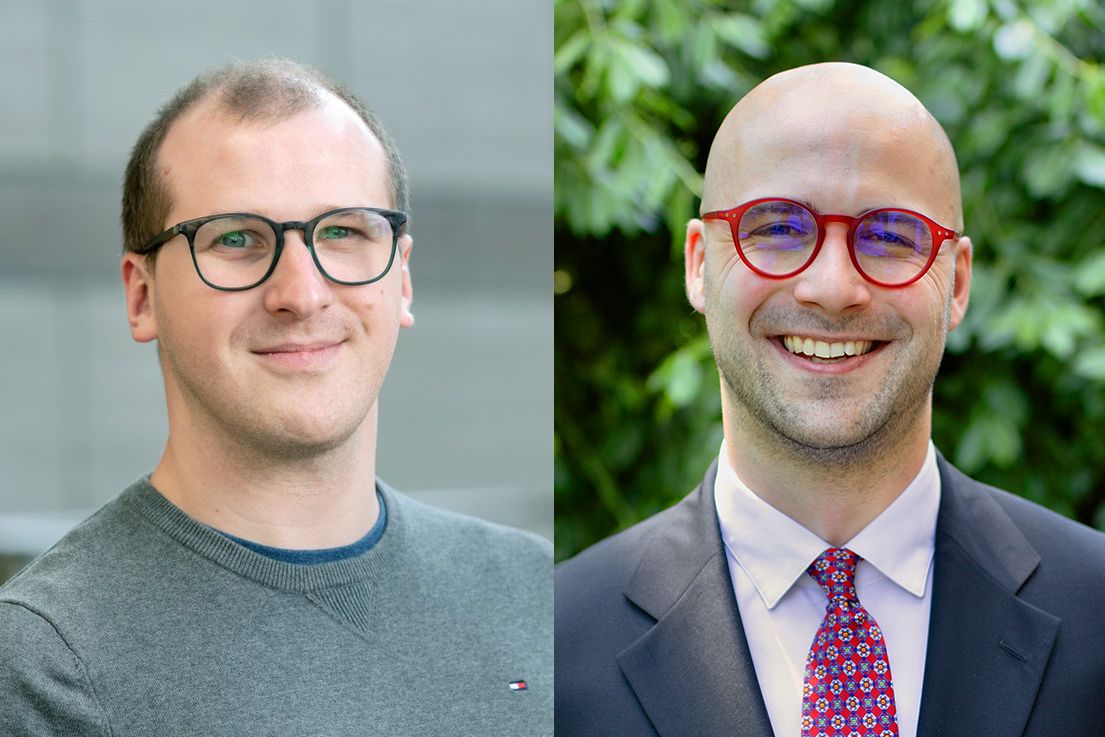
(Vienna, 3 September 2026) Ralf Schmidt (Department of Laboratory Medicine) and Vlad Tereshenko (Department of Plastic, Reconstructive and Aesthetic Surgery) have been awarded prestigious "Starting Grants" by the European Research Council (ERC). Whilst Schmidt aims with his projekt "A-to-B direct" to pave the way for a new generation of cell and gene therapies with his project, Tereshenko’s "VisceraLink" project develops a bionic nerve interface to internal organs, enabling precise, minimally invasive modulation of autonomic control.
"A-to-B direct"
Ralf Schmidt’s project "A-to-B direct" (full title: "A-to-B: Direct Identity Reprogramming to Overcome Scarcity in Cell Therapies") addresses a key challenge facing modern cell therapies: the immune cells most valuable for treatment are naturally rare in the body or depleted by disease and ageing. Particularly in the case of cancer, autoimmune diseases and in transplant medicine, it is often those immune cells that occur in only small numbers which are crucial. Previous approaches to enriching or producing such cells are labour-intensive and quickly reach their limits.
The project is pursuing an approach to specifically convert common immune cells into rare cell types that are particularly valuable for therapeutic purposes. At the heart of this is the idea of reshaping cell properties through targeted genetic programming. In the long term, the aim is to develop a safe, precise and widely applicable platform that paves the way for a new generation of cell and gene therapies.
About Ralf Schmidt
Ralf Schmidt studied medicine at the Medical University of Vienna and was already engaged in scientific research in the field of immunology whilst still a student. After completing his PhD, he undertook his specialist training at the University Clinic for Laboratory Medicine whilst simultaneously continuing his scientific work in the PhD programme in immunology. In 2019, he moved to the Marson Lab at the University of California, San Francisco (UCSF) and the Gladstone Institutes as a postdoctoral researcher, where he developed high-throughput CRISPR screening methods for primary human T-cells. Since 2023, he has been back at MedUni Vienna at the Department of Laboratory Medicine, where he leads a research group focusing on genome editing in primary human T-cells.
"VisceraLink"
Most organ functions are controlled automatically: the heart adjusts blood pressure, the gut orchestrates digestion, and the autonomic nervous system keeps these processes in balance without our conscious awareness. In common conditions such as hypertension and obesity, this balance is disturbed; key reflex pathways in the cardiovascular and metabolic systems drift out of range and often remain difficult to stabilize, even with multiple medications and lifestyle changes.
With the ERC-funded project "VisceraLink" (full title: Selective Sensory Vagal Interface: a bionic platform for internal organ modulation), Vlad Tereshenko aims to build a new, nerve‑centred route to restore this balance. VisceraLink is a sensory‑first, biohybrid interface placed on organ‑specific branches of the vagus nerve, paired with an implantable actuator that delivers controlled biomechanical distension signals, patterns of input that the brain can interpret via existing vagal pathways. By engaging reflex circuits in the cardiovascular and gastrointestinal systems, the team hopes to lower blood pressure, adjust satiety signaling, and improve metabolic control in patients with treatment‑resistant hypertension and obesity.
The program concentrates on key translational milestones: selecting and rerouting suitable vagal branches, creating a durable biological–electronic interface, integrating an implant‑ready, programmable actuator, and establishing robust input‑output relationships in preclinical models. These steps are intended to position "VisceraLink" for early human studies as a platform technology for organ‑specific autonomic modulation and, in the longer term, to open new neuromodulatory treatment options for diseases driven by disordered brain–viscera communication.
About Vlad Tereshenko
Vlad Tereshenko came to Vienna from Minsk, Belarus, to study medicine. At the Medical University of Vienna, he completed a combined MD/PhD programme of excellence at the Clinical Laboratory for Bionic Extremity Reconstruction. Following clinical work in orthopaedics and trauma surgery, he is currently working as a junior doctor at the Department of Plastic, Reconstructive and Aesthetic Surgery at the Medical University of Vienna. Vlad Tereshenko was awarded the FWF Schrödinger Fellowship Award for a two-year research fellowship in the USA. During this research stay, he worked at Massachusetts General Hospital, Harvard Medical School and the Massachusetts Institute of Technology. His research focuses on peripheral nerves, neuromuscular interfaces, bionic reconstructions and biohybrid implants. He is the author of numerous scientific publications and has received several awards for his work, including the PhD Award from the Austrian Society for Surgical Research and the Global Nerve Foundation Young Researcher Award.
Funding for pioneering projects
The ERC Starting Grants from the European Research Council (ERC) support outstanding researchers at the start of their independent research careers in establishing their own research programme or research team. The funding is open to all research topics and is aimed at researchers of all nationalities who wish to carry out a scientifically pioneering project at a research institution in Europe. Starting Grants are endowed with up to 1.5 million euro for a duration of up to five years.