
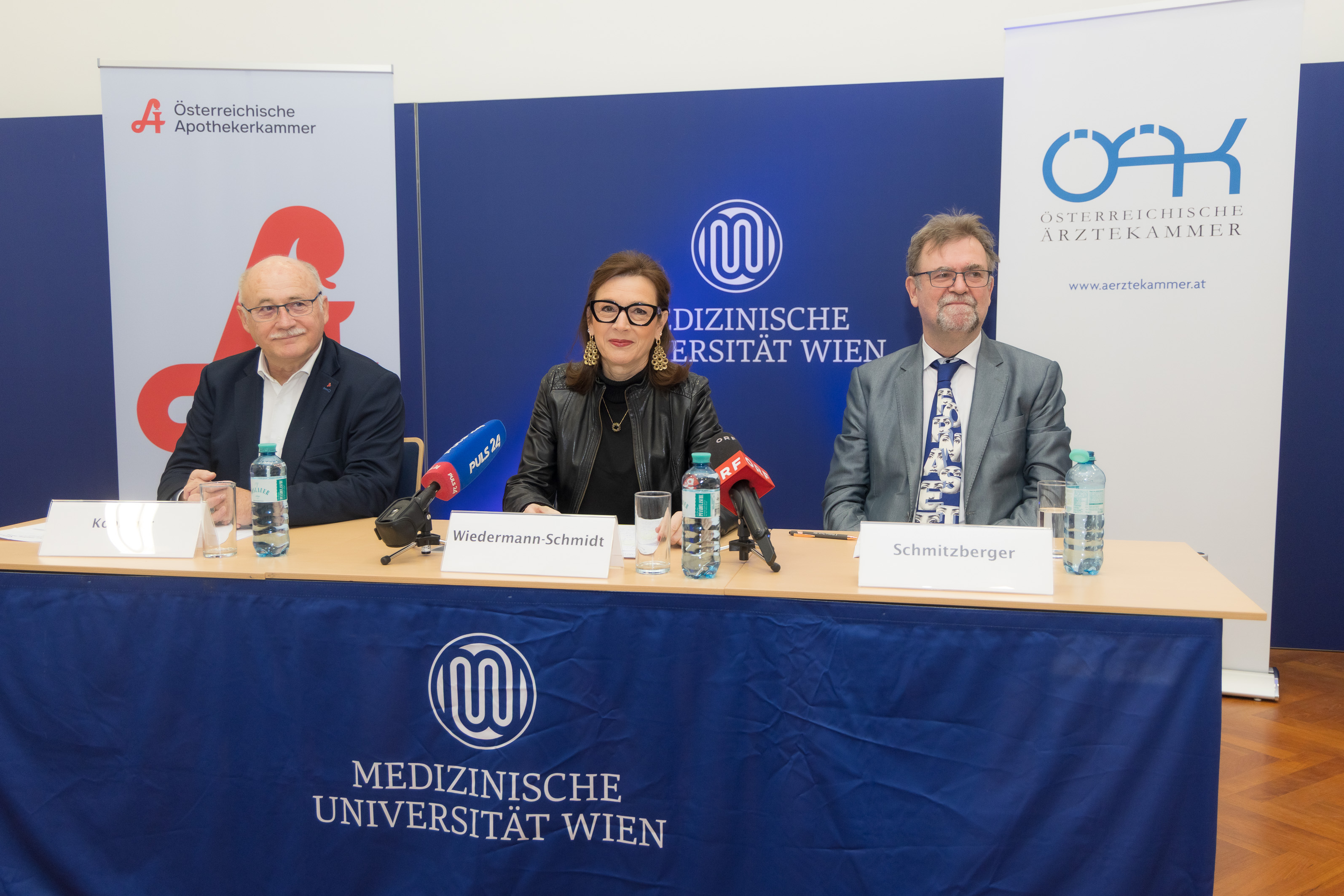
(Vienna, 16 December 2025) Austrian Vaccination Day 2026 will focus on the renewed increase in infectious diseases that had already been greatly reduced by vaccination programmes. Declining acceptance of vaccination among parts of the population is leading to a resurgence of diseases such as measles, whooping cough and hepatitis A. Experts therefore emphasise the importance of new educational methods to promote a better understanding of the long-term benefits of vaccination. Positive examples, such as pneumococcal vaccination in children, demonstrate the added value of vaccination, namely that diseases can be prevented not only in children but also in older adults. Austrian Vaccination Day will take place again on 17 January 2026 as a hybrid symposium at the Austria Center Vienna in cooperation with MedUni Vienna, the Austrian Medical Association, the Austrian Chamber of Pharmacists and the Austrian Academy of Physicians. (Information: www.impftag.at).
Under the title "I'm back – that's when I get vaccinated!", numerous top experts will shed light on current issues relating to vaccination on 17 January 2026 under the medical-scientific chairmanship of Ursula Wiedermann-Schmidt, Head of the Center for Pathophysiology, Infectiology and Immunology at MedUni Vienna. At a press conference today, Tuesday, 16 December 2025, Ursula Wiedermann-Schmidt, Rudolf Schmitzberger, Head of the Vaccination Department of the Austrian Medical Association, and Gerhard Kobinger, 2nd Vice-President of the Austrian Chamber of Pharmacists, spoke, among other things, about the great need to catch up on vaccination coverage rates.
Increasing personal identification with the benefits of vaccination
"We are currently observing that diseases that we had almost eliminated through high vaccination coverage rates are reappearing," explains Ursula Wiedermann-Schmidt. "As vaccine acceptance among the population has fallen sharply, we need to find better or new ways of educating and communicating."
As part of Vaccination Day, the speakers' presentations will focus in particular on the role of social and political factors in the return of infectious diseases. This also involves new ways of communicating the message. "We know that facts alone are not always enough. We need to focus more on personal identification with the topic of vaccination and place the relationship of trust between doctors and patients at the centre," emphasises Wiedermann-Schmidt.
She also points out that vaccinations not only protect against acute illness, but can also have added value in relation to other diseases. For example, influenza or RSV vaccinations can reduce the risk of heart attack or stroke. The same applies to the herpes zoster vaccination, which not only protects against shingles and the associated nerve pain, but can also significantly reduce the risk of dementia. "The benefits of vaccinations therefore go far beyond immediate protection. Most people are unaware of this and it is significantly underestimated in the public perception," says Wiedermann-Schmidt.
The consequences of declining vaccination rates are already visible. Measles is spreading again worldwide, in some cases within a few years. Austria is among the European leaders in terms of new infections. At the same time, examples such as the pneumococcal vaccination programme for children show that well-accepted vaccination strategies indirectly protect not only children but also adults. Conversely, the increase in whooping cough cases illustrates how important regular booster vaccinations are in all age groups. The same applies to hepatitis A – this year, we have seen a threefold increase in hepatitis A cases and even outbreaks because there are significant gaps in vaccination coverage among the population. "This development shows how quickly we lose ground when vaccination coverage declines – and how much we can gain when we take joint responsibility for protecting ourselves against infectious diseases," summarises Wiedermann-Schmidt.
Multifaceted vaccination options at doctors' surgeries
Vaccinations are an important pillar of preventive healthcare, emphasises Rudolf Schmitzberger, head of the Department of Vaccination Affairs at the Austrian Medical Association. "It is important to avoid gaps in vaccination coverage, which is why preventive medical check-ups should include checking vaccination records to keep track of booster shots," he says. He also points out that all doctors can vaccinate: "For example, accompanying persons can get vaccinated by the paediatrician when they are already there for a parent-child passport examination or vaccination," he emphasises the many possibilities for getting vaccinated by registered doctors.
Free HPV vaccination for older people expires
Schmitzberger welcomes the expansion of the public vaccination programme, which has now been extended to include free vaccination against herpes zoster and pneumococci. "It would also make sense to include vaccination against diphtheria, tetanus and pertussis, which must be refreshed every five years in adulthood, in the public vaccination programme," he says. However, the implementation of the public vaccination programme is not going entirely smoothly: "The e-shop for orders is very unstable; ordering is almost like playing the lottery," he says. You need luck to get into the relevant order shop, and even if you manage that, there is still a considerable chance that no vaccine will be available: "The technical and resource problems are causing a lot of frustration among doctors," Schmitzberger sums up. There is still room for improvement here.
Finally, Schmitzberger points out that this is the last chance for 22- to 29-year-olds to receive the HPV vaccination free of charge. While HPV vaccination will remain free for 9- to 21-year-olds in the future, the vaccination campaign for 22- to 29-year-olds will end on 30 June 2026: "However, anyone who also wants to receive the second HPV vaccination free of charge must receive the first HPV vaccination by 31 December at the latest," he says.
Vaccination can save lives
"When it comes to vaccination coverage, there is still no sugar-coating the situation in Austria. As in previous years, the official WHO figures paint a simply disastrous picture. While the global vaccination coverage rate for the third dose of diphtheria, tetanus and pertussis is 93 per cent, Austria is at the bottom of the list with 85 per cent. According to the Agency for Health and Food Safety (AGES), a total of 15,465 cases of pertussis, or whooping cough, were reported in 2024, and a few weeks old baby in Styria even died from it. This is roughly equivalent to the infection rate in 1959, before the introduction of the national vaccination programme. And that should give us all pause for thought," says Gerhard Kobinger from the Austrian Chamber of Pharmacists, summarising the current situation.
According to the WHO, there is a similarly poor vaccination coverage rate for measles (second dose 91 per cent worldwide, 84 per cent in Austria) and polio (third dose 93 per cent worldwide, 85 per cent in Austria). "It is alarming how carelessly people treat their health and their lives, because vaccinations save lives! And it is precisely this message that must be conveyed. Among other places, in Austria's 1,470 pharmacies. More than 7,000 pharmacists provide information about vaccination options and also point out gaps in vaccination coverage. That's why I'm appealing to everyone to have their vaccination records checked at the pharmacy," Kobinger urges.
Austria's pharmacies provide low-threshold access to reliable information about vaccination. There are hardly any waiting times, and highly trained experts are available behind the counter to answer questions. Professional vaccination advice is part of their daily routine. It doesn't matter whether it's initial vaccinations for children and adolescents or booster shots for adults. A trained look at customers' vaccination records – whether analogue or digital – by pharmacists is also part of this routine. "Booster intervals, for example for TBE or diphtheria, tetanus, pertussis and polio, can change with age. But hardly anyone pays attention to this. However, the appropriate protection against various diseases can only be guaranteed by booster shots at the right intervals. That's why a vaccination record is important at any age," Kobinger concludes.
New vaccines for travel medicine
New vaccines for travel medicine will also be presented at the Austrian Vaccination Day. A vaccine against chikungunya is new to the programme, as is a vaccine against dengue fever. The latest data on HPV vaccination and the decline in HPV-associated cancers due to vaccination will also be presented.
Austrian Vaccination Day provides a valuable platform for professional exchange on vaccination topics and underlines the importance of a socially supported and active vaccination system.
www.impftag.at