
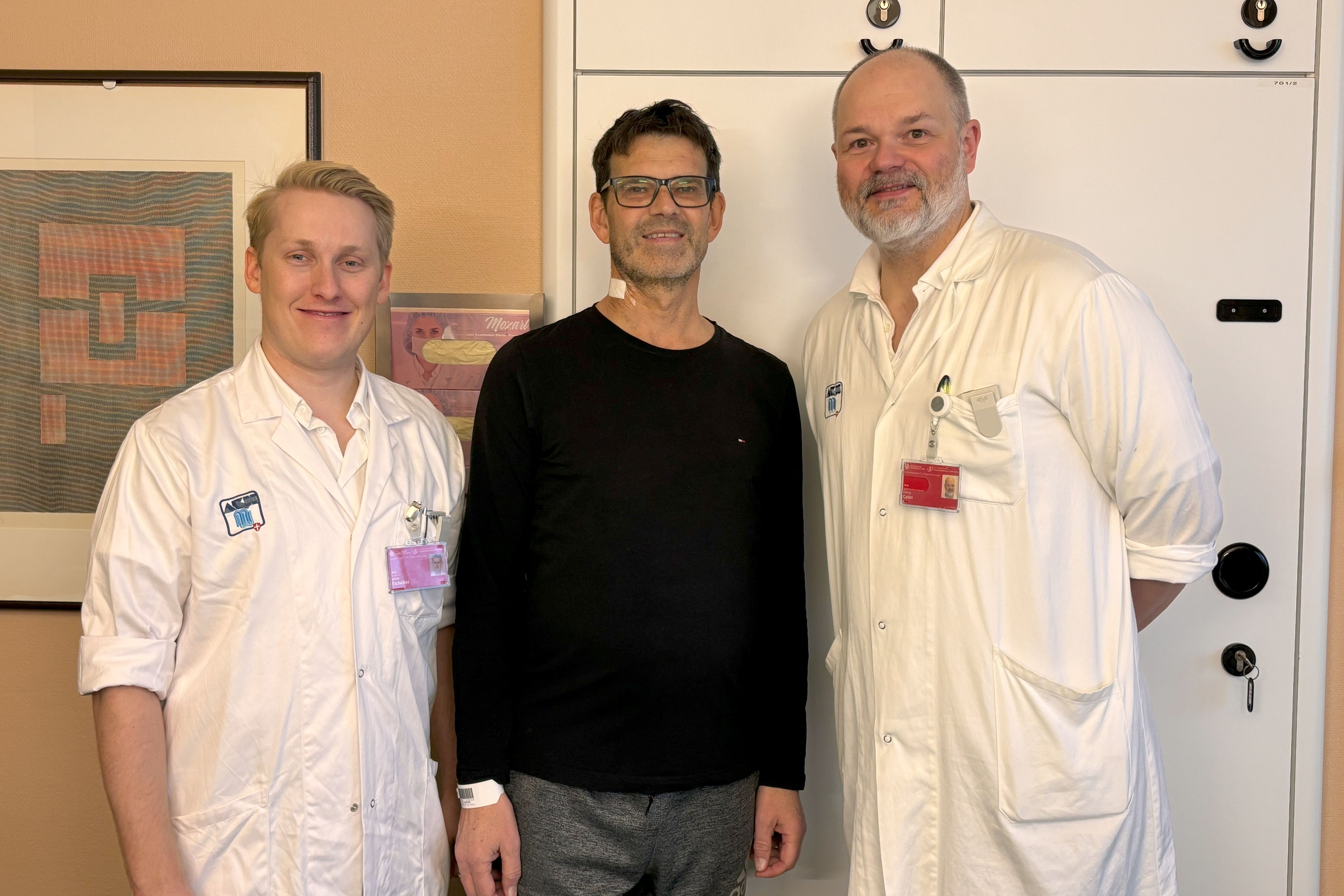
(Vienna, 30-12-2025) Under the direction of Jakob Eichelter and Georg Györi, a robot-assisted kidney transplant programme has been successfully implemented for the first time in Austria at the Clinical Division of Transplantation at the Department of General Surgery at University Hospital Vienna and the Medical University of Vienna.
Since the programme was launched in December 2024, 20 kidneys have already been successfully transplanted using the state-of-the-art DaVinci Xi surgical robot system. The 20th robot-assisted kidney transplant was recently performed on a 57-year-old man from Lower Austria. The results are in line with promising international experiences and set new standards in minimally invasive transplant surgery.
A special feature of the Vienna programme is that both the removal of the kidneys from living donors and the transplantation into recipients are performed entirely with robotic assistance. This integrated approach makes the Vienna centre unique in the Austrian context.
Shorter hospital stays and minimisation of complications
The results to date show exceptionally high safety and quality: the operations were performed without complications, and the postoperative course showed significantly lower complication rates than with open surgery. "Our results to date impressively confirm that robot-assisted kidney transplants offer significant advantages due to the minimally invasive approach, while maintaining a comparably high level of quality in terms of organ quality," says Jakob Eichelter.
These advantages are particularly pronounced in patients with obesity, who benefit especially from smaller incisions, fewer post-operative complications and shorter hospital stays. "The possibility of performing the operation with small incisions can also open up new opportunities for patients who previously had to be rejected for a kidney transplant," explains Georg Györi, interim head of the Clinical Department of Transplantation. Head of the Clinical Division of Transplantation.
Optimal interdisciplinary and interprofessional cooperation
The success of the programme is based on close cooperation between surgery and nephrology, Rainer Oberbauer and Georg Böhmig. The implementation in the operating theatre was excellently supported by the entire surgical nursing team in Operating Theatre Group V of the University Hospital Vienna, led by nursing station manager Natalie Libera.
"We are at the beginning of a new era in transplant surgery. Robotic surgery will define new standards in the medium term – and we are proud to be helping to shape this development in Austria," emphasises Eichelter.