
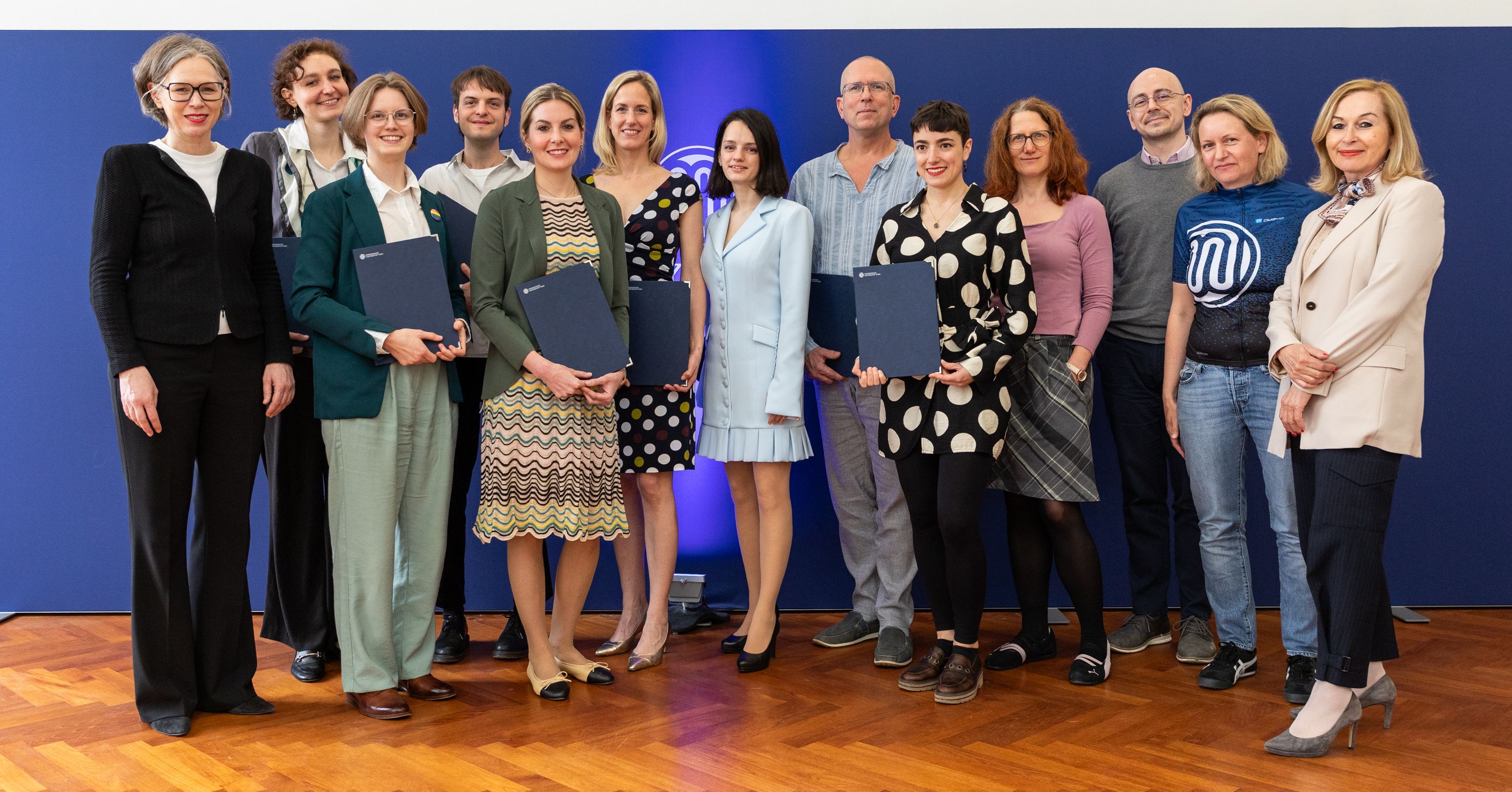
(Vienna, 23 April 2026) The Medical University of Vienna has awarded the Veronika Fialka Moser Diversity Prizes 2026. The prizes were awarded to theses and projects in the categories of undergraduate/master’s theses and community engagement that address various dimensions of diversity in medicine, healthcare and education. The winning entries range from palliative care and queer perspectives in everyday medical practice to transcultural psychiatry, humanitarian surgery and international educational cooperation.
The Veronika Fialka Moser Diversity Award from MedUni Vienna recognises contributions that highlight diversity in medicine and drive structural improvements for patients, students and staff. This year’s award-winning works and projects address, among other things, accessible communication, queer visibility in the healthcare sector, mental health in crisis situations, culturally sensitive care, and international cooperation in the development of medical services.
Category: Bachelor’s/Master’s theses
1st Place: Sarah Winsauer – “The Experience of Palliative Care in Comics: A Qualitative Study with Affected Patients”
This study examines how comics are perceived as a medium for providing information about palliative care. The results: A medical graphic about palliative care can be experienced as informative, uplifting, reassuring, and engaging. The artistic educational material can also lead to a shift in perspective away from finality and towards more positive associations with the field. What is particularly noteworthy is that six palliative care patients were involved in the development of the educational comic, allowing the experiences of those affected to be directly incorporated into the design.
2nd place: Melanie Giwiser – “If I have to think about it, then it’s not the same”: Experiences of queer medical professionals in their everyday working lives
Melanie Giwiser’s thesis provides the first systematic insight into the experiences of queer medical students and doctors in training in Austria. Based on 17 qualitative interviews, the thesis shows that many of those affected are confronted in their daily work with minority stress, experiences of discrimination, cis-heteronormativity and the pressure to hide their own identity. At the same time, the study makes it clear that queer medical professionals can make important contributions to more sensitive care for queer patients. From this, the study derives structural recommendations including greater visibility of queer issues, a culture of respectful communication and a stronger integration of queer health content into the curriculum.Melanie Giwiser’s thesis provides the first systematic insight into the experiences of queer medical students and doctors in training in Austria. Based on 17 qualitative interviews, the thesis shows that many of those affected are confronted in their daily work with minority stress, experiences of discrimination, cis-heteronormativity and the pressure to hide their own identity. At the same time, the study makes it clear that queer medical professionals can make important contributions to more sensitive care for queer patients. From this, the study derives structural recommendations including greater visibility of queer issues, a culture of respectful communication and a stronger integration of queer health content into the curriculum.
3rd place: Nora Rosenberg, Klara Rosta, Antonia Mazzucato-Puchner – “Implications of the COVID-19 Pandemic for Sexuality, Family Planning, and Mental Health Among Women of Reproductive Age with Rheumatic Diseases”
As part of this thesis, a prospective questionnaire study was conducted on the effects of the COVID-19 pandemic on sexuality, family planning and mental health among women of reproductive age with rheumatic diseases. No significant differences were found between the groups studied in terms of family planning, sexual function, or symptoms of depression and anxiety; however, women with rheumatic diseases reported lower levels of stress and less fear of the coronavirus. Access to rheumatological care emerged as the most important predictor of mental health. The results suggest resilience and underscore the importance of continuous medical care for mental health in crisis situations.
Category: Commitment
1st place: Viktoria König – “Humanitarian microsurgical reconstructions in East Africa”
The project involves a multi-year commitment to providing surgical care to patients in resource-limited and war-torn regions, particularly in Tigray in northern Ethiopia. Since 2019, complex reconstructive surgeries have been performed there for severe gunshot and blast injuries. A central component is the sustainable development of microsurgical expertise in collaboration with local teams, based on a “train-the-trainer” approach. The project combines highly specialized medicine with global responsibility, intercultural cooperation, and sustainable knowledge transfer.
2nd place: Josef Baumgartner – Specialist Outpatient Clinic for Transcultural Psychiatry and Migration-Related Mental Disorders
The specialized outpatient clinic at the Clinical Department of Social Psychiatry is designed for people whose mental health is affected by migration, experiences of displacement, language barriers or discrimination. The program focuses on low-threshold, culturally and trauma-sensitive care and works closely with the hemayat therapy centre. Measures such as video interpretation services, the involvement of family members and the coordination of follow-up care close to home are designed to improve the quality of care and break down structural barriers.
3rd place: Daniela Gompelmann, Christina Bal, Christian Stanislaw – “Bronchoscopy without obstacles”
The goal of the project is to establish a permanent bronchoscopy service in Kumasi, Ghana. Although the necessary equipment is available on site, there has been a lack of training and experience in performing the procedure. Through a bronchoscopy course in 2024 and an in-depth follow-up in 2025, local doctors and nursing staff were gradually introduced to performing the procedure independently. The project demonstrates how medical training, intercultural collaboration and sustainable capacity building can work together.