
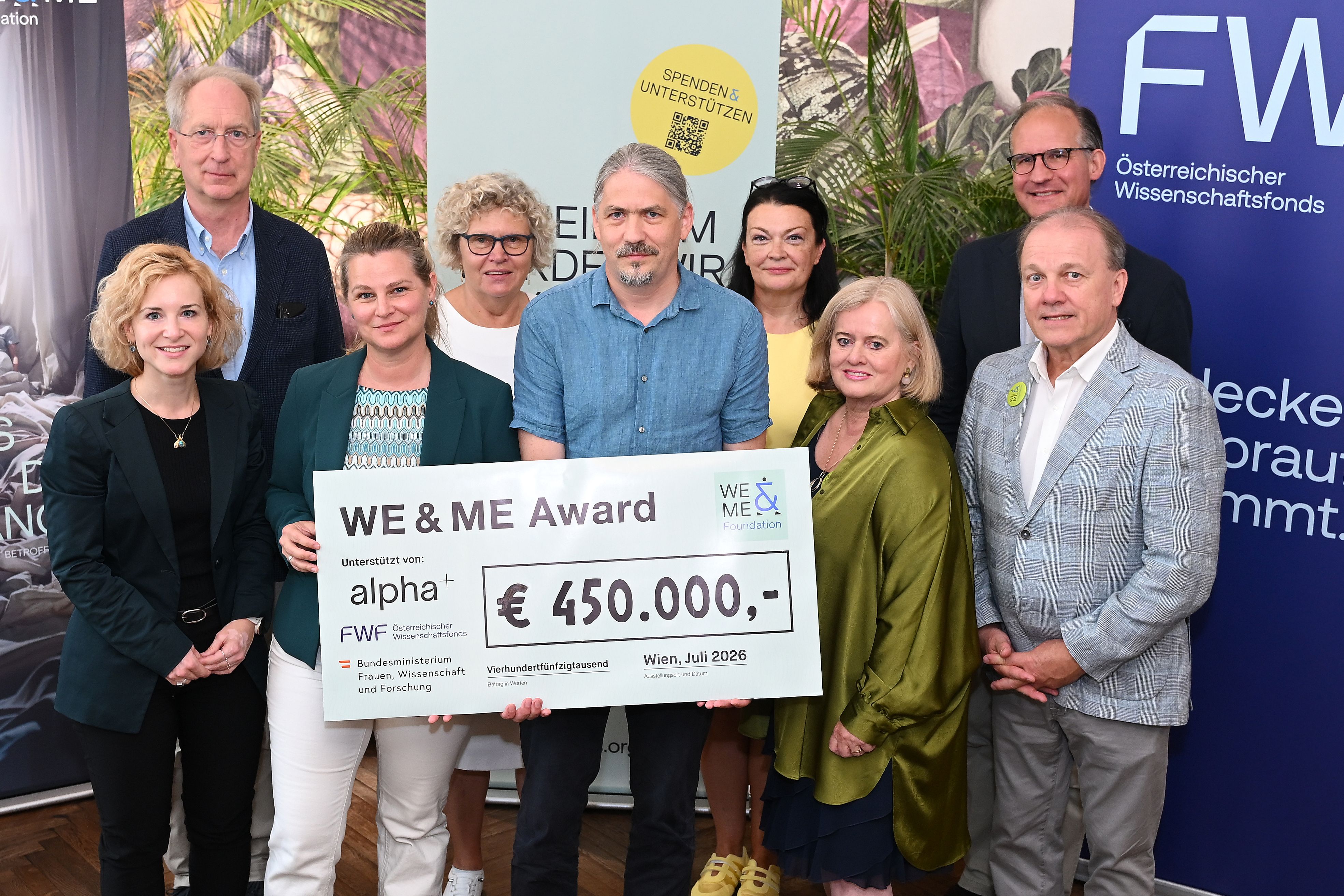
(Vienna, 8 July 2026) Gaining new scientific insights into the multisystemic condition ME/CFS – this is the aim of the WE&ME Foundation. Thanks to the WE&ME Award, awarded via the FWF’s alpha+ Foundation, epidemiologist Matthias Wielscher from the Medical University of Vienna is able to investigate why the disease does not progress in the same way for everyone. The WE&ME Foundation is providing 450,000 euros for this project. In addition, the FWF is funding three further ME/CFS projects in Vienna and Innsbruck with 1.3 million euros.
Presented for the first time, the WE&ME Award, worth 450,000 euros, is one of the most highly endowed privately funded research prizes in Austria and supports basic research into the multisystemic condition ME/CFS. Following a competitive selection process based on international expert reviews, epidemiologist Matthias Wielscher and three other researchers were selected. Wielscher’s project has been awarded the WE&ME Award and will be funded by a donation of 450,000 euros from the WE&ME Foundation to the alpha+ Foundation. In addition, the Austrian Science Fund (FWF) is funding three further research projects on ME/CFS with a total of 1.3 million euros.
“We are delighted to receive support from the WE&ME Foundation and the FWF. This funding gives us the opportunity to systematically advance our genetic research into ME/CFS. Our aim is to gain a better understanding of genetically distinct subgroups of the condition and thereby lay the foundations for more precise diagnostics and future personalised therapeutic approaches,” said Matthias Wielscher regarding the WE&ME Award.
“We selected Matthias Wielscher’s project because, for us, recognising the heterogeneity of this condition is a central aspect of current biomedical research into ME/CFS, and because a lack of patient stratification prevents consistent study results and, consequently, targeted therapies. Genetic studies and correlations enable more precise subtyping, with the aim of unravelling different disease mechanisms and, consequently, providing starting points for diagnostics and therapies. “The necessary international networking and collaboration with the largest genetic dataset for ME/CFS (DecodeME) – the sequencing of which is supported, amongst others, by WE&ME – is also a key component of this project,” said Gabriele Ströck of the WE&ME Foundation on the selection for the WE&ME Award.
“Behind every research question on ME/CFS are people whose lives have been fundamentally altered by this serious illness. It severely restricts the lives of thousands of sufferers whilst still raising many scientific questions. This makes it all the more important that, through the WE&ME Award and three further projects funded by the FWF, we are making targeted investments in excellent basic research. The award-winning projects lay
important foundations for better understanding the biological causes of the condition and developing new approaches to diagnosis and treatment. My sincere thanks go to the
WE&ME Foundation for its exceptional commitment. Together with the FWF, we are enabling research that creates concrete prospects for those affected,” said Minister for Science Eva-Maria Holzleitner.
“The new projects demonstrate that it is possible to expand excellent basic research through private donations to the alpha+ Foundation and, in this specific case, to improve our understanding of ME/CFS. “I would like to extend my special thanks to the WE&ME Foundation for its extraordinary commitment on behalf of thousands of patients. Partnerships between public funding bodies and private foundations create additional opportunities to facilitate scientific progress where it is most urgently needed,” said FWF Vice-President and alpha+ Board Member Ursula Jakubek.
“I am delighted that two further research projects on ME/CFS are able to get underway at MedUni Vienna. Partners such as the WE&ME Foundation are making an important contribution to advancing research in this field. They are creating additional opportunities to investigate a condition that we still need to understand much better,” said Markus Müller, Rector of the Medical University of Vienna.
WE&ME Award: Unravelling biological differences in ME/CFS
ME/CFS is a highly heterogeneous condition. Patients differ not only in their symptoms but also, in all likelihood, in the biological mechanisms underlying their condition. However, when all those affected are studied together, these different disease mechanisms overlap. This makes it more difficult to identify genetic causes and develop new therapeutic approaches.
With the WE&ME Award, Matthias Wielscher and Kathryn Hoffmann as contributing researcher will investigate this heterogeneity from two different perspectives as part of the ‘Mechanistic Endotypes in ME/CFS’ project, and use this to identify biologically meaningful subgroups of patients.
The first approach is based on clinical data. Here, the team analyses symptoms, comorbidities, treatment attempts and questionnaire data from large patient cohorts. The aim is to identify patients who exhibit similar disease courses or combinations of symptoms. The second approach utilises genetic data. In this case, the researchers do not focus on individual genes, but rather combine many genetic variants into genetic mechanism scores. Each of these scores describes the genetic influence on a specific biological process, such as inflammatory reactions, autoimmunity, disturbances in energy production or the intestinal barrier. In this way, individual biological profiles are created. It is expected that some affected individuals will show a stronger genetic influence on inflammatory processes, whilst in others, genetic alterations associated with autoimmunity or impairments in vascular or barrier function will predominate. These patterns are then analysed to identify genetically defined subgroups of ME/CFS. A particular focus of the project is the comparison of these two approaches. The aim is to investigate whether clinically defined and genetically defined subgroups corroborate one another, thereby enabling a better understanding of the biological diversity of ME/CFS. Finally, we will search for these newly defined subgroups in the world’s largest genetic dataset for ME/CFS (DecodeME) in order to carry out further genome-wide analyses. Matthias Wielscher expects that this will reveal genetic correlations that have remained hidden in previous analyses due to the high level of heterogeneity. In the long term, this improved understanding of the different disease mechanisms could help to develop more precise diagnostics and identify new targets for targeted therapies or the repurposing of already approved medicines.
The project builds on the findings of a research project led by Matthias Wielscher, which was funded in 2024 by the WE&ME Foundation and the Vienna Science, Research and Technology Fund (WWTF).
A further 1.3 million euros for ME/CFS projects from the Austrian Science Fund (FWF)
In addition to Matthias Wielscher’s project, which is made possible by the WE&ME Foundation’s private donation to the alpha+ Foundation, three further projects were selected in the FWF funding process on the basis of their quality and degree of innovation: Mirjam Bachler from the Medical University of Innsbruck with the project “Individualised therapeutic approaches for ME/CFS-PAIS with PEM”, Lilian Konicar from the Medical University of Vienna with the project “INSPIRE: Individualised neurotherapy for CFS/ME – PEM”, and Katharina Ledebur from the Complexity Science Hub Vienna with the project “TRACK-PEM: Recording and Analysis of Post-Exertional Malaise”. These three projects will receive a total of 1.3 million euros in funding from the FWF.