
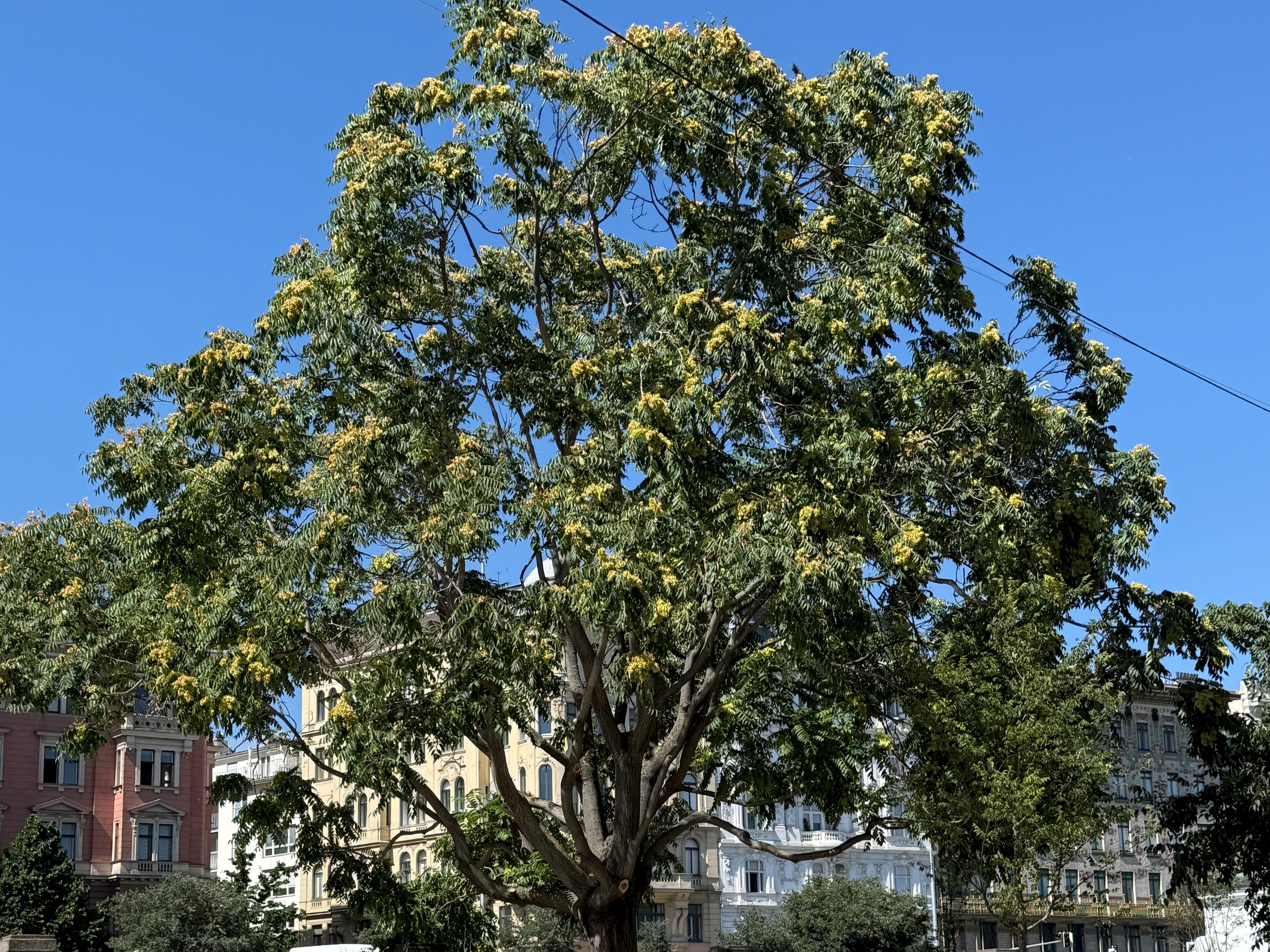
(Vienna, 01 June 2026) Bad news for allergy sufferers: the flower of the tree of heaven has begun. It usually lasts from early June to mid-July. A publication by the research group of the Pollenservice Vienna at MedUni Vienna now shows the development of tree of heaven pollen dispersal in Vienna for the first time over almost 50 years. The results illustrate that climate change has already altered the tree of heaven’s flowering season and that pollen concentrations are rising.
The tree of heaven (Ailanthus altissima) is known as an invasive neophyte and has spread from its original home in China and northern Vietnam to temperate and subtropical regions across all inhabited continents. In Austria, efforts are actively being made to prevent its distribution. The tree of heaven arrived in Europe a long time ago and was planted as an ornamental tree in Berlin as early as 1780. However, it only began to spread massively across Europe after the Second World War. It has been inlcuded on the EU list of invasive species since 2019 (EU Regulation 2019/1262).
As an allergen, it is a special case, as the tree is not purely wind-pollinated (like birch and grasses, for example), but primarily insect-pollinated. However, a large amount of pollen is released during pollination, and it is considered capable of being pollinated by both insects and wind. In its native country China, sensitisation rates of up to 30% have been reported among pollen allergy sufferers.
The current flowering phase of the tree of heaven
The tree of heaven has started to flower. Maximilian Bastl from the Pollen Service Vienna at MedUni Vienna explains: “This is a rather early start of the flowering season due to the heat. Pollen dispersal benefits from sunshine and high temperatures. If the weather remains summerly warm and dry, we have to expect a more intense season.”
The tree of heaven last flowered more intensely in 2024; at the peak of that season in Vienna, there was more tree of heaven pollen in the air than grass pollen. The flowering period of the tree of heaven overlaps with the main flowering season of grasses. Incidentally, the grass pollen season is making things difficult for pollen allergy sufferers this year due to a mix of different grass species flowering at the same time.
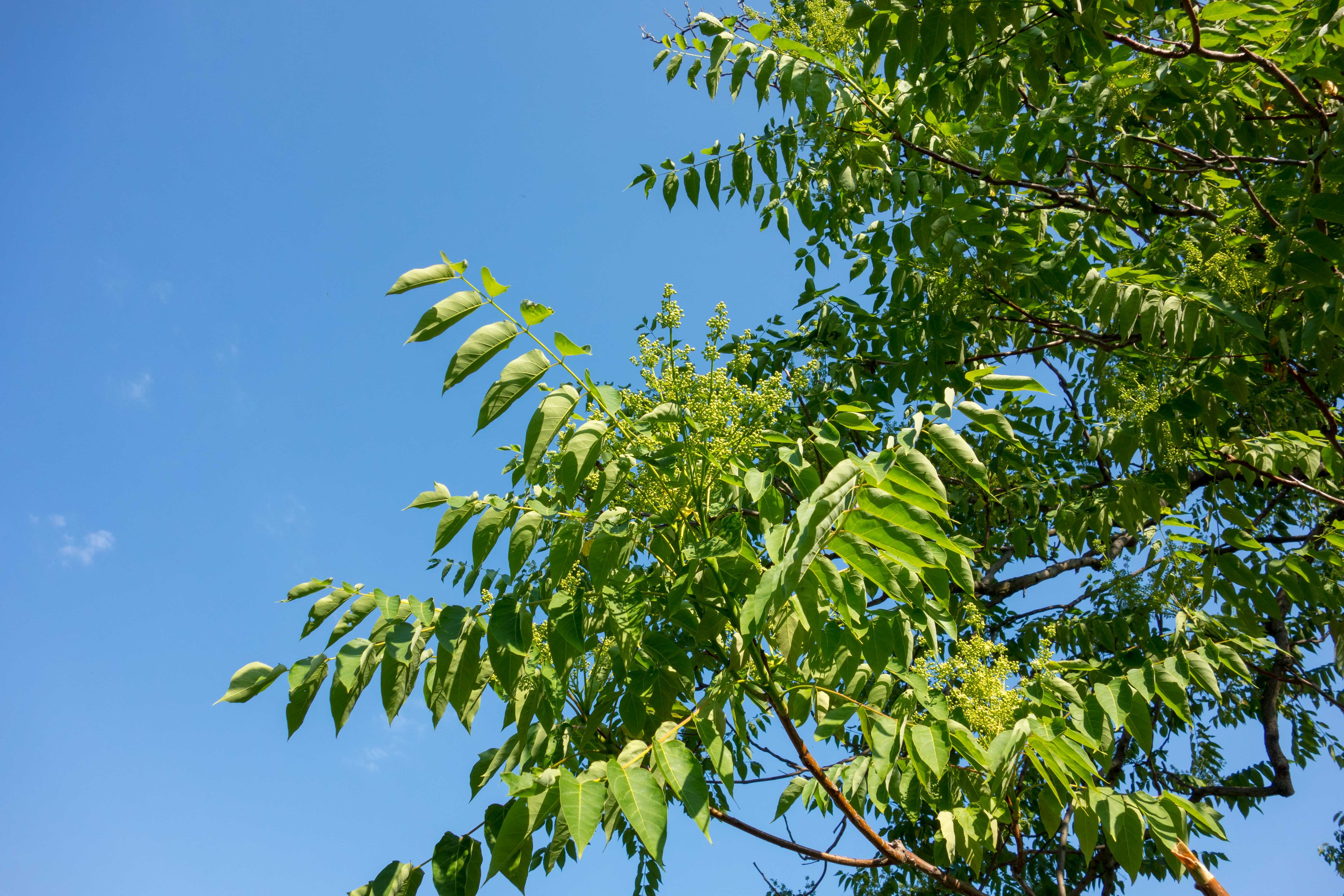
Tree of heaven: the all-rounder
The tree of heaven is a very resilient plant. It tolerates air pollution, heat, drought, high salinity, herbicides, pruning, and grows even on compacted soil and infertile or contaminated ground. Since it adapts particularly well to the urban climate, it is considered a climate-resilient tree.
Additionally, it is highly competitive because it has an allelopathic (inhibiting) effect on other plants and the germination of their seeds. In Central Europe, it is most commonly found in the warmest parts of towns and cities. Its roots can also cause damage to infrastructure.
Allergenic potential
Tree of heaven pollen is considered a relevant aeroallergen. The allergenic proteins have been described multiple times, and clinical data indicate significant sensitisation rates in China and (on a smaller scale) also in parts of Europe.
However, tree of heaven pollen is currently not available in standard routine allergy tests, and large-scale studies on sensitisation rates in Austria and large parts of Europe are still missing.
The tree of heaven in the context of climate change
Pollen data on the tree of heaven is rarely published. The longest data series (48 years) has now been published and analysed by MedUni Vienna. Temperature and sunshine hours showed the highest correlation with pollen concentrations. Furthermore, an increase in the total amount of tree of heaven pollen, an earlier start and an earlier peak of the pollen season were observed. In metropolises like Vienna, the ‘urban heat island’ effect additionally occurs, which can intensify this trend.
Katharina Bastl from the Pollen Service Vienna at MedUni Vienna explains: “For the first time, the increase in pollen concentrations for the tree of heaven has been scientifically proven. We must assume this trend will continue given the current progression of global warming.”
This is because the tree of heaven can also spread from urban heat islands into the surrounding areas, establish itself in natural habitats and damage native ecosystems.
Further information
Publication by MedUni Vienna on the impact of climate change on the pollen dispersal of the tree of heaven (Bastl et al. 2025, Plants): https://www.mdpi.com/2223-7747/14/24/3823
Pollen forecast and website of the Pollen Service Vienna, MedUni Vienna: www.pollenservice.wien
Social media presence of Pollenservice Vienna: “Pollenpaar” on Instagram, Bluesky, X, TikTok