
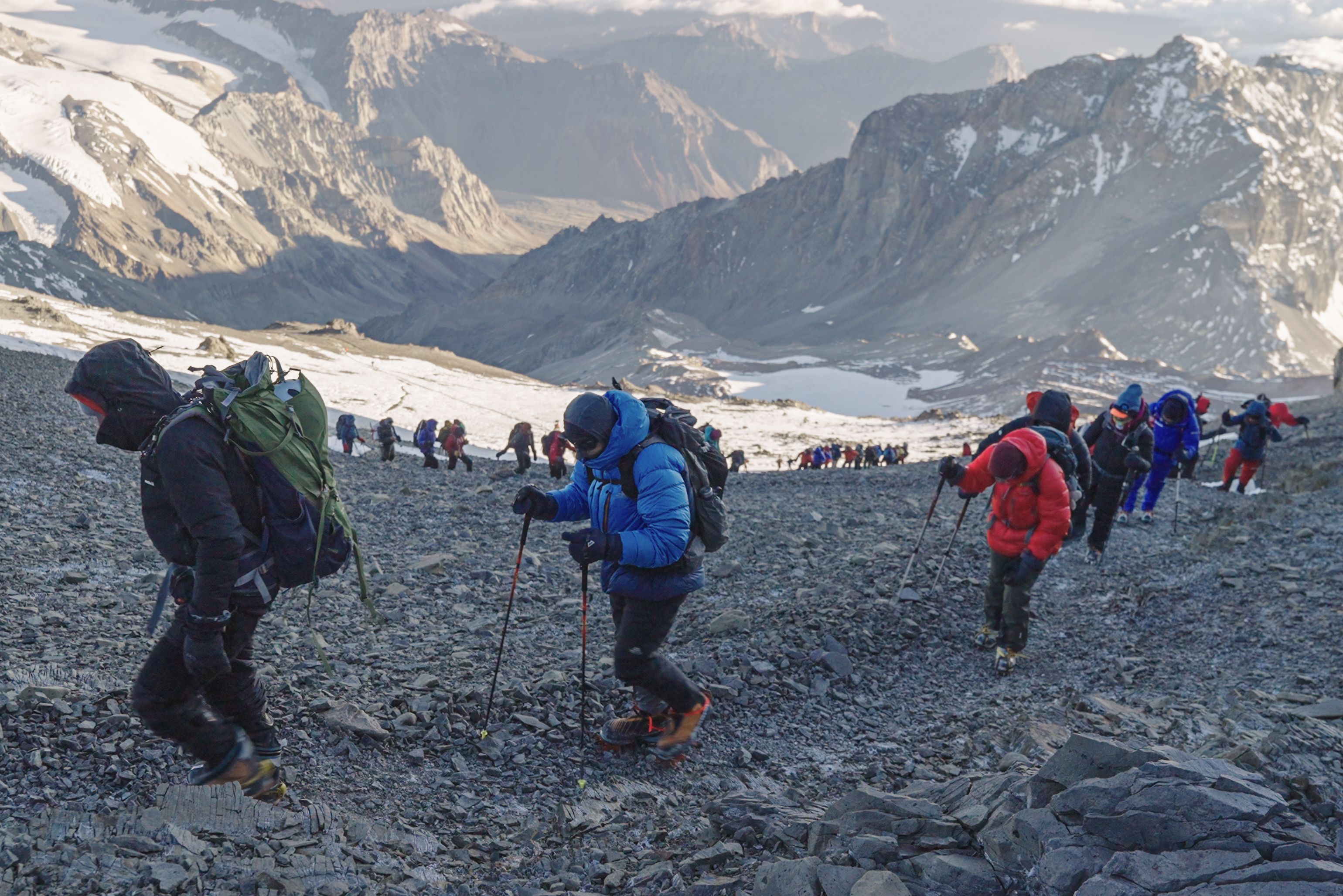
(Vienna, 16 June 2026) A research team, with significant involvement from the Medical University of Vienna, has published new medical data on physical adaptation following lung transplantation under extreme high-altitude conditions. The publication appeared in the journal Transplant International and describes the observations from the expedition initiated and accompanied by MedUni Vienna doctors, involving nine transplant recipients, to the 6,961-metre-high Aconcagua in Argentina in January 2026.
Eight people who had undergone lung transplants and one liver transplant patient took part in the expedition to the highest mountain in the Americas. They were carefully selected in advance on the basis of lung function and stress tests and were accompanied during the 19-day ascent of Aconcagua by an international medical team, including doctors from MedUni Vienna. The medical data collected during the expedition document the body’s response to the drastically reduced oxygen availability at high altitude. The detailed physiological data in the current publication relate primarily to the 51-year-old patient who underwent a lung transplant at University Hospital Vienna in 2002 due to cystic fibrosis and is being treated at the Department of Thoracic Surgery at MedUni Vienna. He was the only transplant recipient to reach the 6,961-metre summit without additional oxygen.
Careful preparation and monitoring
Prior to the expedition, the participants underwent at least 200 hours of so-called hypoxic conditioning over a period of 36 days; the eventual summit climber clocked up a total of 311 hours. This involves simulating a high-altitude environment using oxygen-depleted air to gradually acclimatise the body to lower oxygen levels. During the expedition, the research team continuously monitored heart rate, oxygen saturation and symptoms of acute mountain sickness. The measurements showed significant changes in oxygen supply as the altitude increased. The partial pressure of oxygen in arterial blood – a measure of oxygen uptake in the lungs – fell from 82 mmHg to 42 mmHg at base camp at an altitude of 4,350 metres. Blood oxygen saturation decreased with increasing altitude to as low as 75 per cent. At the same time, the acid-base balance remained stable, and the heart rate changed only slightly. To assess potential altitude sickness, the team used the internationally established Lake Louise Score. Only mild to moderate symptoms were observed. Severe altitude-related complications such as high-altitude pulmonary oedema or high-altitude cerebral oedema were not observed.
Results not applicable to all lung transplant patients
The MedUni Vienna publication not only highlights what patients are capable of following a lung transplant, but "also the responsibility and prudence of the medical team", according to the editorial in the specialist journal "Transplant International". "Great care was taken to acclimatise and monitor patients in order to avoid the potential negative consequences of extreme physical activity following an organ transplant." However, the authors of the publication emphasise that the results are not transferable to all patients following lung transplantation. "The observations do, however, show that transplanted lungs can remain functionally adaptable even under conditions of extreme oxygen deprivation, provided this is done under controlled conditions and with careful medical supervision," says Jakob Mühlbacher from the Department of General Surgery at MedUni Vienna, who accompanied the expedition to the summit.
Publication: Transplant International
What Is Possible for Patients After Lung Transplantation? The Highest Reported Altitude Achieved by a Lung Transplant Recipient Without Supplemental Oxygen - Climbing Mount Aconcagua (6.961m).
Jakob Mühlbacher*, Alexis Slama, Konrad Hötzenecker, Christina Jelly, Holger Flick, Fedja Dzubur,
Matthias P. Hilty, Paul Fellinger, Rodrigo Duplessis, Lukas Furtenbach, Ida Valerie Wedenig, Wilfried Wisser, Clemens Aigner, Peter Jaksch.
https://doi.org/10.3389/ti.2026.16591
Editorial: Transplant International
Living Life to the Fullest After Organ Transplantation.
https://doi.org/10.3389/ti.2026.16595