
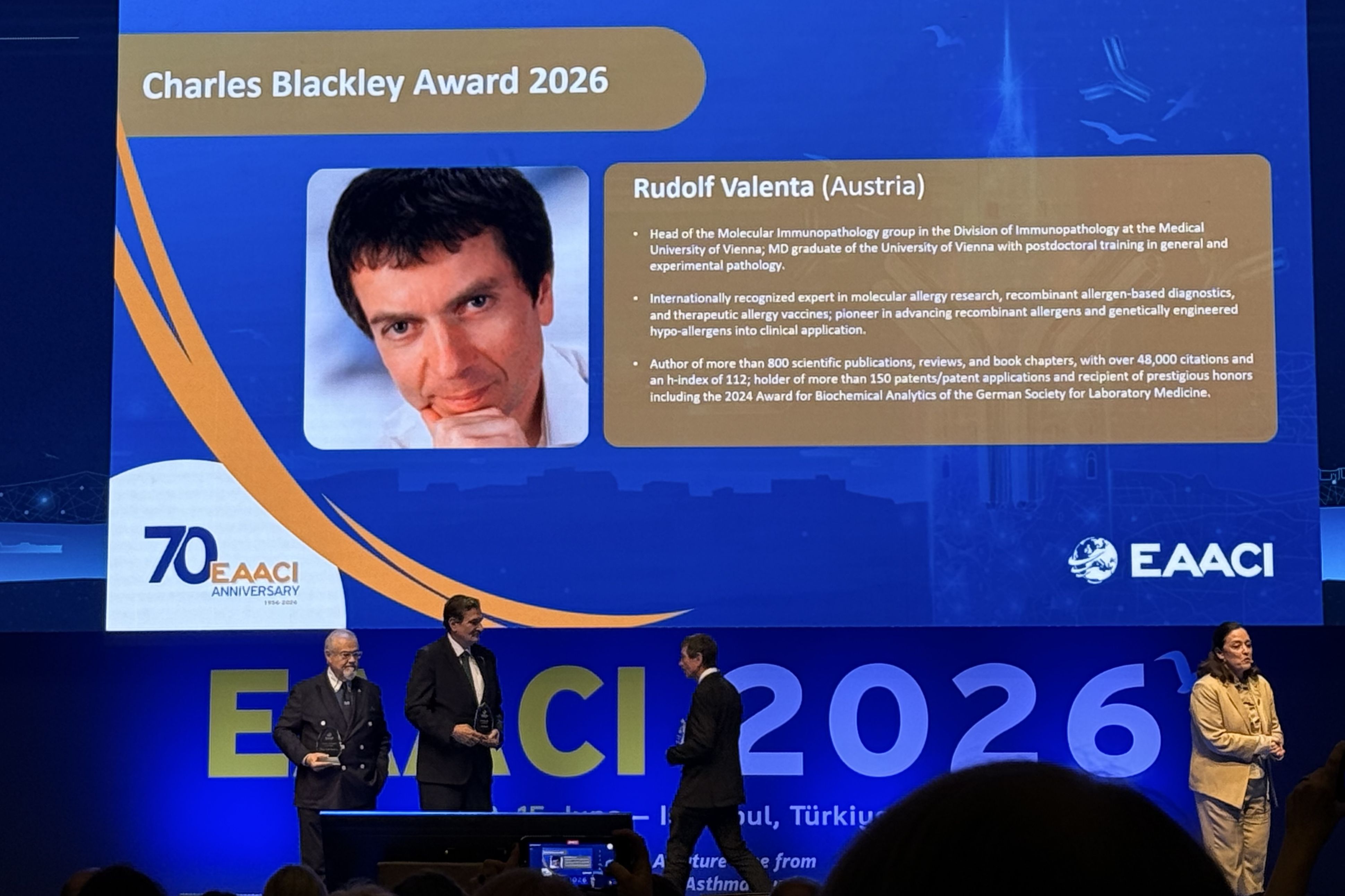
(Vienna, 24 June 2026) Rudolf Valenta of the Medical University of Vienna has been awarded the Charles Blackley Award by the European Academy of Allergy and Clinical Immunology (EAACI). The award was presented during the EAACI Congress 2026 in Istanbul and recognises his internationally recognised scientific achievements in allergology and immunology.
The Charles Blackley Award is one of the EAACI’s most prestigious scientific honours. It is named after Charles Harrison Blackley, who, in the 19th century, described the link between pollen and hay fever, thereby laying the foundations for modern allergy research.
Through his work in molecular allergology, Rudolf Valenta has played a key role in shaping the modern diagnosis and treatment of allergic diseases. His research focuses on recombinant allergens, molecular allergy diagnostics and the development of new, more precise therapeutic approaches. His work has made a significant contribution to a better understanding of allergic diseases at the molecular level and to their more targeted treatment.
The award was presented during the EAACI Congress 2026, which took place in Istanbul from 12 to 15 June. At the event, the European Academy of Allergy and Clinical Immunology recognised outstanding scientific contributions in the fields of allergy, asthma and clinical immunology.
About the recipient
Rudolf Valenta is an allergist at the Medical University of Vienna and heads the Department of Immunopathology at the Institute of Pathophysiology and Allergy Research within the Center for Pathophysiology, Infectiology and Immunology. He studied at the Faculty of Medicine at the University of Vienna, completed his habilitation in General and Experimental Pathology, and specialised in pathophysiology and immunology. He has been Professor of Allergology at MedUni Vienna since 2004. His scientific work has had a particular impact on molecular allergy diagnostics, the development of recombinant allergens and new approaches to the treatment of allergic diseases.