
(Vienna, May 20, 2026) The federal government has informed the Conference of Universities that it plans to cut university budgets. The cut is to take an unprecedented form: it will not merely involve freezing the current budget and failing to compensate for cost increases. Instead, a full billion euros is to be cut from the current budget.
The starting point for the current performance agreement period (2025–2027) is 16.5 billion euros, including physicians’ salaries at university hospitals. Based on WIFO forecasts, the universities had conservatively estimated that the upcoming performance agreement period (2028–2030) would require 18 billion euros just to offset cost increases. Out of consideration for the serious state of the federal budget, the universities had refrained from making aggressive demands.
The federal government’s response is to cut university funding to 15.5 billion. This represents a 6% reduction from the baseline and a shortfall of 2.5 billion—or 13.9%—compared to the actual funding requirement.
"A Declaration of Bankruptcy by the Federal Government"
The government aims to save 2.5 billion euros in the 2027–2028 budget. In comparison, the 2.5 billion euros in cuts to universities over three years is absolutely disproportionate. Universities account for four percent of the total budget; cuts of this magnitude will have a devastating effect on them.
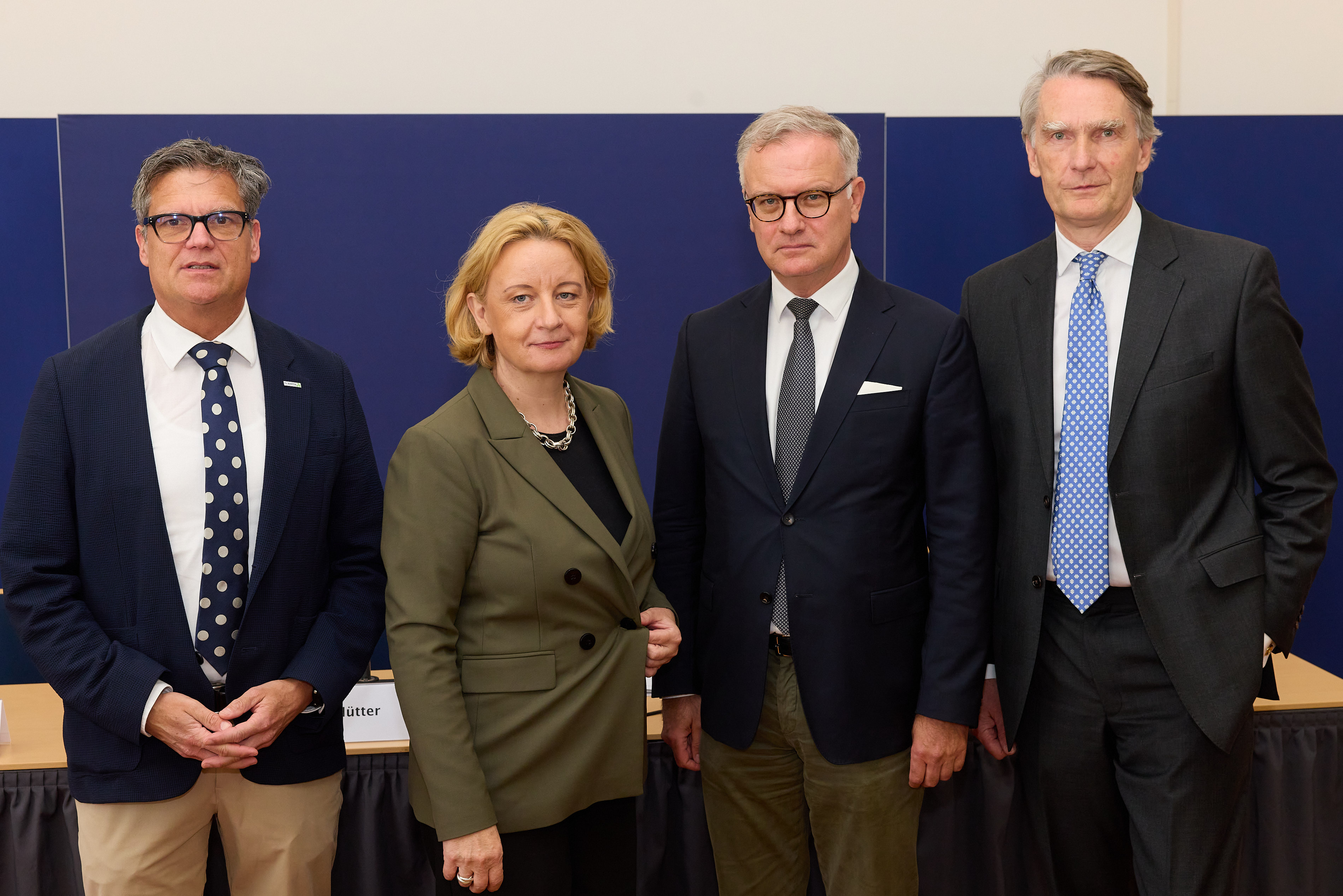
"This is a declaration of bankruptcy regarding the importance this federal government attaches to universities," says uniko President Brigitte Hütter at a joint press conference with uniko Vice President and MedUni Vienna Rector Markus Müller, the Rector of the University of Vienna, Sebastian Schütze, and the Rector of the Vienna University of Technology, Jens Schneider. It is "sobering" and "disappointing", said Hütter, to be confronted with such a breach of trust by this very government. "It has presented itself as a safe haven for scientists fleeing Trump. Now Austria isn’t even a safe haven for its own universities."
EU Wants to Double Science Budget, Austria Cuts
Just as in the business world, reliability and long-term funding are prerequisites for success in science. That is why planning security plays a major role in the University Act. The University Act and the autonomy of universities are a success story that many in Europe envy us for. The planned cuts are a particularly harsh blow to this track record of success, and it will take a long time to recover from them.
At the EU level, efforts are currently underway to double the budget for science and research—or at least to increase it massively (from just under 100 to at least 175 billion)—in order to remain competitive. During the budget briefing, uniko was told, word for word: “Science and research are not priorities for this federal government.”
Hütter: "If that is really the case, I can only say: Then investments in the future, the training of skilled workers, the country’s competitiveness and innovative strength, as well as research to solve pressing problems like climate change are not priorities for this federal government."
Impact of cuts in numbers
On Tuesday, experts at the universities examined the federal government’s cutback plans and calculated what they mean.
A 2.5 billion shortfall in the 2028–2030 budget means an average shortfall of 800 million per year.
A few comparative figures:
- Tuition fees for all universities: just under 60 million (2024)
- Third-party funding for all universities: approx. 1 billion (2024)
- Personnel expenses for all universities (including third-party funding): approx. 4 billion (2024)
Funding gap affects early-career researchers and staff
700 million euros per year would mean a reduction of around 20 percent in staff, meaning that one in five people could no longer be employed.
Question for policymakers: How are salary increases to be funded in the future? Through layoffs for cost-cutting purposes? And how will the demanded conversion of young researchers’ fixed-term contracts to permanent ones be made possible?
Impact on the quality of education
The student-to-faculty ratio is a fundamental prerequisite for high-quality education and is also evaluated in several key rankings. In terms of “professors and equivalents,” the planned budget cut would result in a reduction of 1,000 full-time positions. The student-to-faculty ratio would consequently rise from the current 1:34 to 1:42. This would run counter to the goals of the Ministry of Science in the Austrian Higher Education Plan 2030, which sets a target ratio of 1:35.
The funding gap impacts the labor market
If the duration of studies is extended by an additional year, this has far-reaching consequences for the labor market and economic value creation. Graduates will enter the labor market later as a result, leading to a shortage of skilled workers.
In the winter semester of 2025 alone, this affects nearly 40,000 graduates (= 40,000 person-years(!)), who, due to the extended duration of studies, would not be available to the labor market until a year later.
Loss of the Austrian economy’s future viability and competitiveness
A de facto 14% cut compared to the budget required to account for inflation affects not only the universities—it strikes at the very heart of Austria’s competitiveness as a hub for technology and business. Fewer university graduates—precisely when the economy and research need more, not less. Especially in new technologies such as AI or cybersecurity.
Collapse of university medical care
The four university hospitals in Vienna, Graz, Linz, and Innsbruck form the backbone of cutting-edge medical care in Austria and are, in many cases, the only and last resort for severe and specialized conditions. The Vienna General Hospital (AKH) currently provides about one-third of all medical care in Vienna. Furthermore, the majority of Austria’s medical specialists and medical graduates are trained at these four university hospitals. Cuts on the scale planned by the government would result in a collapse of university medical care and a massive reduction in the number of doctors in Austria.
The Austrian Universities Conference