
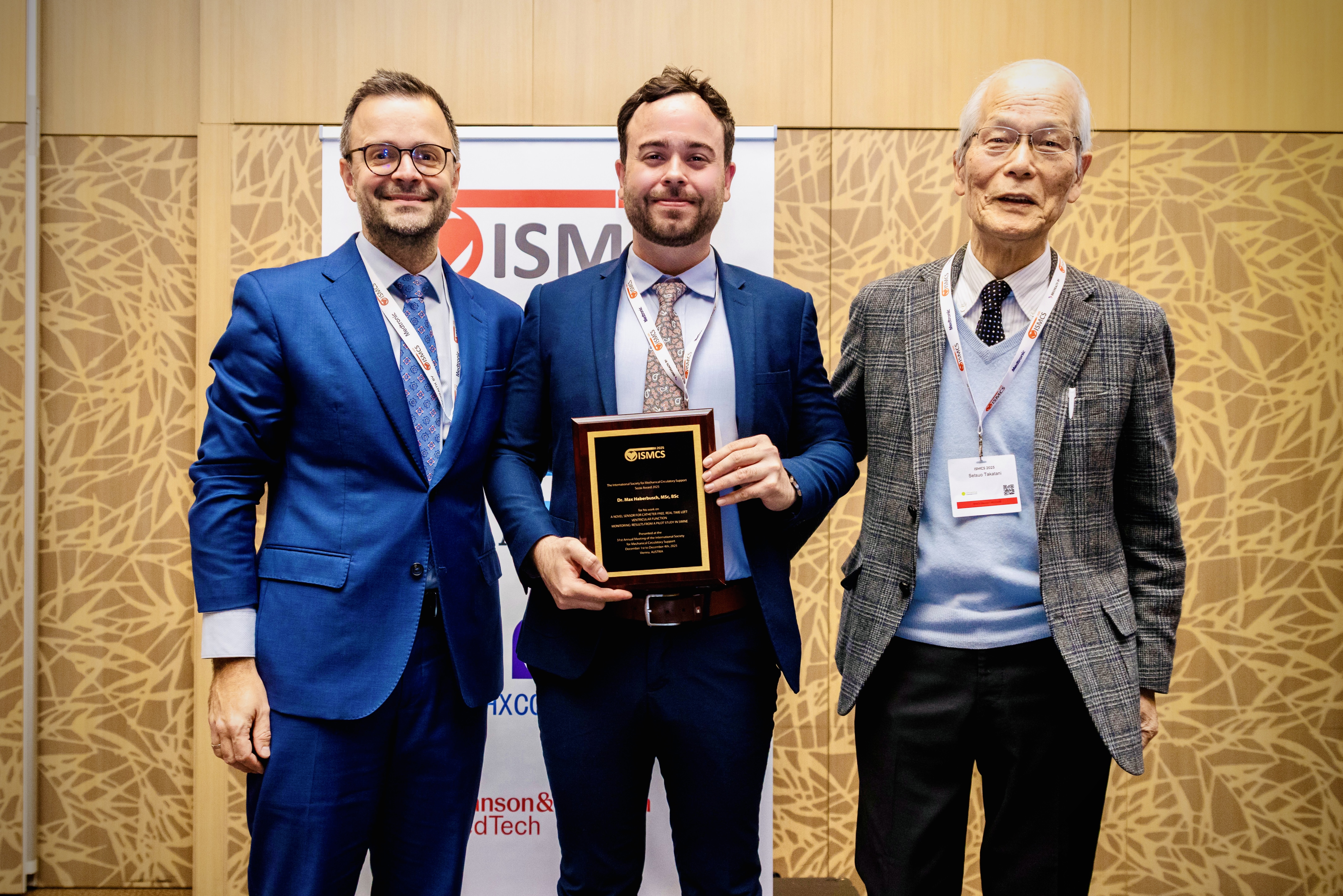
(Vienna, 09 December 2025) Max Haberbusch from the Center for Medical Physics and Biomedical Engineering at MedUni Vienna was presented with the Sezai Award at the International Society for Mechanical Circulatory Support (ISMCS) conference. Max Haberbusch received the award for his team's innovative work as part of CARDISENSE. The aim of the project is to develop a catheter-free sensor for real-time monitoring of left ventricular function.
The Sezai Award – named after Yukiyasu Sezai, former President of Nihon University (Japan) – recognises outstanding and innovative research presented at the ISMCS conference. The award-winning work focuses on a novel sensor developed for catheter-free real-time monitoring of heart function.
Innovation in mechanical circulatory support
As the number of patients worldwide who require mechanical circulatory support continues to rise, the need for safer, non-invasive monitoring solutions has never been greater. Currently, precise haemodynamic monitoring often requires invasive catheters. The CARDISENSE project aims to remove this obstacle and offer a sensor solution that could significantly improve patients' quality of life and safety.
This project is being carried out under Haberbusch's leadership in collaboration with the Fraunhofer Institute for Microengineering and Microsystems. It is based in Francesco Moscato's working group and is supported by the Austrian Research Promotion Agency (FFG).
"I am incredibly honoured to receive this recognition from the ISMCS community," said Max Haberbusch. "It validates our vision that the future of heart failure management lies in continuous, blood-contact-free monitoring that enables proactive patient management instead of reactive care."
Advances in edge AI
The group also made a strong showing in the field of artificial intelligence. PhD student David Lung presented his research on xLSTM-based ECG delineation, demonstrating near-expert-level signal analysis running directly on edge devices. This approach enables highly accurate cardiac monitoring on energy-efficient wearables – a crucial step for practical application and data privacy.